k-story-lessons

A Rainy Night at a Korean Convenience Store: Beginner Korean Reading Practice

k-fiction.com 2026. 7. 16. 11:24

A Rainy Night at a Korean Convenience Store

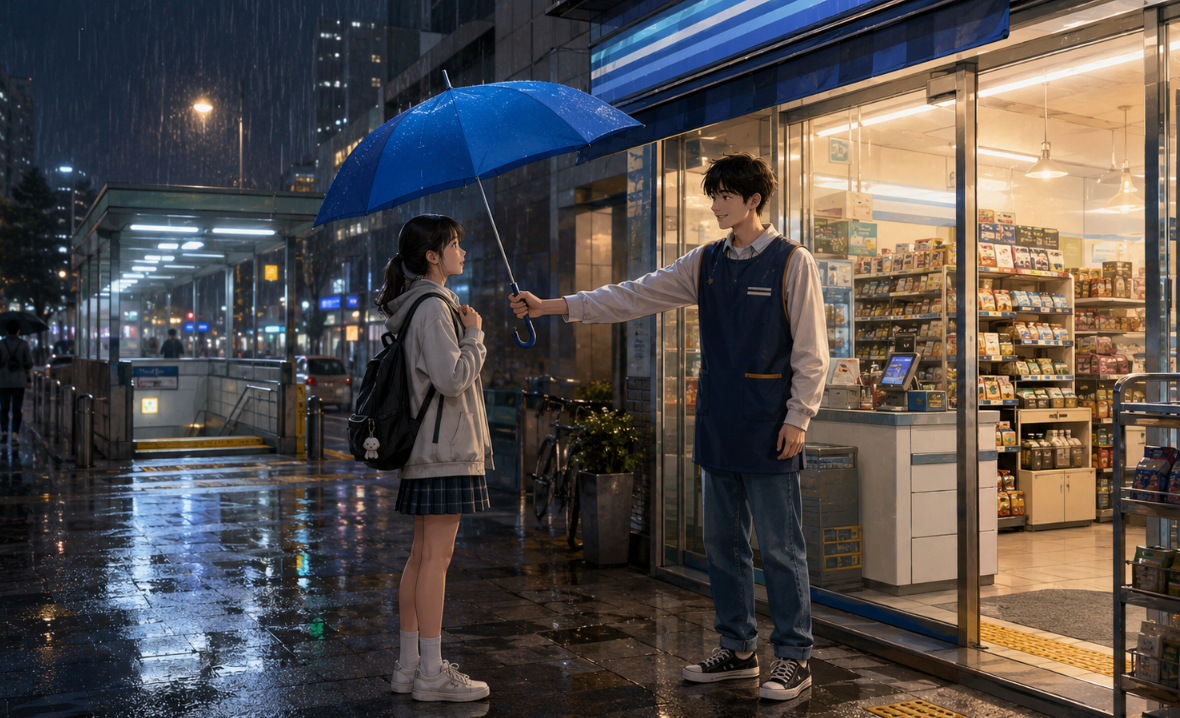
Reading Korean becomes easier when vocabulary, grammar, and emotion appear inside one memorable scene. In this lesson, you will read an original short story about two students meeting outside a convenience store on a rainy night.

This story is written for learners around the A2 to early B1 level. You do not need to understand every word during your first reading.

What You Will Learn

By the end of this lesson, you will be able to:

  • understand a short Korean scene without translating every word;
  • recognize polite speech between two strangers;
  • use expressions such as 두고 오다, -아/어 보이다, and -실래요?;
  • understand why 괜찮아요 does not always mean that someone is truly fine;
  • practice reading, inference, and sentence rewriting.

1. Read the Korean Story First

Created by AI

비 오는 날의 파란 우산

비가 오후부터 쉬지 않고 내렸다.

지수는 야간 수업이 끝난 뒤 지하철역 앞 편의점 처마 밑에 서 있었다. 아침에 가져온 우산은 학교 도서관에 두고 왔다.

“이대로 뛰어갈까?”

휴대폰 지도에는 집까지 걸어서 18분이라고 적혀 있었다.

그때 편의점 문이 열리고, 아르바이트생 민호가 파란 우산을 들고 나왔다.

“혹시 이거 쓰실래요?”

지수는 젖은 운동화를 내려다봤다.

“아니에요. 괜찮아요.”

민호도 지수의 운동화를 바라봤다.

“별로 괜찮아 보이지 않는데요.”

지수는 결국 웃음을 터뜨렸다.

“그럼 우산은 어떻게 돌려드려요?”

민호는 주머니에서 영수증 한 장을 꺼냈다. 그리고 영수증 뒤에 자신의 이름을 적었다.

“다음에 비 오는 날 가져오세요.”

지수는 우산을 받아 들고 편의점을 나왔다. 우산을 펴려던 순간, 영수증 아래에 적힌 작은 문장이 눈에 들어왔다.

저도 월요일마다 야간 수업을 들어요.

지수는 우산을 펴다 말고 유리문 너머를 돌아봤다.

민호는 이미 계산대로 돌아가 있었다. 하지만 유리문에 비친 그의 얼굴은 조금 웃고 있었다.


2. Natural English Translation

The Blue Umbrella on a Rainy Day

It had been raining without stopping since the afternoon.

After her evening class ended, Jisu stood beneath the awning of a convenience store near the subway station. She had left the umbrella she brought that morning in the school library.

“Should I just run home like this?”

The map on her phone said that her home was an eighteen-minute walk away.

At that moment, the convenience store door opened. Minho, the part-time worker, came outside holding a blue umbrella.

“Would you like to use this?”

Jisu looked down at her wet sneakers.

“No, thank you. I’m fine.”

Minho looked at her shoes too.

“You don’t look very fine.”

Jisu finally burst out laughing.

“Then how should I return the umbrella?”

Minho took a receipt from his pocket and wrote his name on the back.

“Bring it back the next time it rains.”

Jisu accepted the umbrella and walked out of the store. Just as she was about to open it, she noticed a small sentence written below his name.

I also take an evening class every Monday.

Jisu stopped halfway through opening the umbrella and looked back through the glass door.

Minho had already returned to the counter. However, the face reflected in the glass was smiling a little.


3. Sentence-by-Sentence Notes

비가 오후부터 쉬지 않고 내렸다.

쉬지 않고 literally means “without resting.”

In this sentence, it means that the rain continued without stopping.

  • 쉬다: to rest
  • -지 않고: without doing
  • 내리다: to fall, used for rain or snow

A natural translation is:

It had been raining continuously since the afternoon.


우산은 학교 도서관에 두고 왔다.

두고 오다 means to leave something somewhere and come away without it.

Compare:

  • 우산을 도서관에 뒀어요.
    I left the umbrella at the library.
  • 우산을 도서관에 두고 왔어요.
    I left the umbrella at the library and came here without it.

The second sentence emphasizes that the speaker is now in a different place from the umbrella.


이대로 뛰어갈까?

이대로 means “in this state,” “as things are,” or “just like this.”

-ㄹ까? can be used when someone is wondering about a possible action.

Here, Jisu is talking to herself:

Should I just run home like this?


혹시 이거 쓰실래요?

혹시 makes a question sound more careful or less direct.

쓰다 can mean “to use,” but it is also the verb normally used with an umbrella:

  • 우산을 쓰다: to use or hold an umbrella over oneself

-실래요? is a polite way to ask whether someone would like to do something.

The sentence is therefore softer than simply saying:

이거 쓰세요.
Use this.


아니에요. 괜찮아요.

괜찮아요 is often translated as “I’m fine” or “It’s okay,” but its function depends on the situation.

In this scene, Jisu is not saying that she is completely comfortable. She is politely declining the offer because she does not want to inconvenience Minho.

Her wet shoes show that her words and her real situation do not match.


별로 괜찮아 보이지 않는데요.

-아/어 보이다 means “to look” or “to appear.”

  • 피곤해 보여요.
    You look tired.
  • 행복해 보여요.
    You look happy.
  • 괜찮아 보이지 않아요.
    You do not look okay.

별로 is commonly used with a negative expression and means “not particularly” or “not really.”

The ending -는데요 makes Minho’s observation sound less sharp and leaves space for Jisu to respond.


우산은 어떻게 돌려드려요?

돌려주다 means to return something.

When the speaker uses 드리다 instead of 주다, the action is expressed respectfully toward the other person.

  • 돌려줄게요.
    I’ll return it to you. Casual.
  • 돌려드릴게요.
    I’ll return it to you. Polite or respectful.

Because Jisu and Minho do not know each other well, 돌려드려요 is natural here.


다음에 비 오는 날 가져오세요.

This sentence does not specify a date.

Literally, it means:

Bring it on the next day when it rains.

Minho could have given Jisu a specific deadline. Instead, he connects their next meeting to another rainy day. This makes the sentence practical, but it also creates a quiet emotional possibility.


우산을 펴다 말고

-다가 말다 or the shortened pattern used here describes beginning an action and then stopping before finishing it.

  • 문을 열다 말고 뒤를 봤어요.
    I stopped halfway through opening the door and looked back.
  • 말을 하다 말았어요.
    I started to speak but stopped.

Jisu begins opening the umbrella, notices the message, and pauses.


4. Key Vocabulary

KoreanMeaningExample
야간 수업 evening class 오늘 야간 수업이 있어요.
지하철역 subway station 지하철역 앞에서 만나요.
편의점 convenience store 편의점에서 물을 샀어요.
처마 awning or edge of a roof 처마 밑에서 비를 피했어요.
두고 오다 to leave something behind 휴대폰을 집에 두고 왔어요.
젖다 to become wet 신발이 비에 젖었어요.
내려다보다 to look down at 바닥을 내려다봤어요.
웃음을 터뜨리다 to burst out laughing 친구가 웃음을 터뜨렸어요.
돌려드리다 to return respectfully 내일 책을 돌려드릴게요.
영수증 receipt 영수증을 버리지 마세요.
받아 들다 to receive and hold 우산을 받아 들었어요.
눈에 들어오다 to catch one’s eye 작은 글씨가 눈에 들어왔어요.
유리문 glass door 유리문을 열었어요.
비치다 to be reflected 얼굴이 창문에 비쳤어요.

5. Why Do They Use Polite Korean?

Jisu and Minho appear to be close in age, but they are meeting as strangers. For that reason, both use polite endings such as:

  • 쓰실래요?
  • 괜찮아요.
  • 돌려드려요?
  • 가져오세요.
  • 들어요.

Age is important in Korean, but age is not the only factor. Familiarity, setting, role, and social distance also affect speech style.

If the two characters become close later, their language may gradually change. That change would show a change in their relationship, not merely a change in grammar.


6. Reading Questions

Try answering without checking the translation again.

  1. Why is Jisu standing outside the convenience store?
  2. Where did she leave her umbrella?
  3. Why does she initially refuse Minho’s offer?
  4. What does Minho write on the receipt?
  5. Why does Jisu stop while opening the umbrella?
  6. What detail suggests that Minho may want to meet her again?

7. Grammar Practice

Complete each sentence.

  1. 휴대폰을 집에 ________ 왔어요.
    I left my phone at home.
  2. 많이 피곤해 ________.
    You look very tired.
  3. 제가 내일 책을 돌려________.
    I will return the book to you politely.
  4. 문을 열________ 뒤를 봤어요.
    I stopped halfway through opening the door and looked back.
  5. 혹시 이 의자에 앉으________?
    Would you like to sit in this chair?

8. Change the Speech Level

Imagine that Jisu and Minho have become close friends.

Rewrite these polite sentences in casual Korean.

  1. 이거 쓰실래요?
  2. 괜찮아요.
  3. 어떻게 돌려드려요?
  4. 다음에 가져오세요.
  5. 저도 월요일마다 수업을 들어요.

9. Answers

Reading Questions

  1. Her evening class has ended, it is raining, and she has no umbrella.
  2. She left it in the school library.
  3. She does not want to inconvenience Minho, even though she is already wet.
  4. He writes his name and a message saying that he also takes an evening class every Monday.
  5. She notices the message on the receipt.
  6. He tells her to return the umbrella on another rainy day and mentions his Monday class.

Grammar Practice

  1. 두고
  2. 보여요
  3. 드릴게요
  4. 다 말고
  5. 실래요

Casual Korean

  1. 이거 쓸래?
  2. 괜찮아.
  3. 어떻게 돌려줘?
  4. 다음에 가져와.
  5. 나도 월요일마다 수업 들어.

10. A Four-Pass Study Method

First reading: Follow the scene

Read only the Korean story. Do not stop for every unknown word. Identify the people, place, problem, and final discovery.

Second reading: Confirm the meaning

Read the English translation and compare it with your first impression.

Third reading: Notice the language

Return to the Korean story and mark five useful expressions. Recommended expressions from this story are:

  • 쉬지 않고
  • 두고 오다
  • 이대로
  • 괜찮아 보이다
  • 펴다 말고

Fourth reading: Retell the story

Close the text and describe the scene in simple Korean. You do not need to repeat the original sentences exactly.

For example:

지수는 우산이 없었어요. 비가 많이 왔어요. 민호가 우산을 빌려줬어요. 영수증에 메시지가 있었어요.

Being able to retell the scene is more useful than memorizing the entire story.


Final Thought

괜찮아요 is a simple Korean expression, but in this story it carries politeness, hesitation, and a little embarrassment. That is why learning through a scene can be more meaningful than memorizing one translation.

Read the story once more and pay attention to the moment when Jisu says she is fine. Her words say one thing, but her wet shoes say something else.

That difference is where natural language begins.