Many Korean learners believe that memorizing vocabulary means looking at a long word list again and again. They write down Korean words, add translations, cover one side of the page, and test themselves repeatedly. This method can help in the beginning, but it often has one big problem: the words feel disconnected from real life.
A word by itself is easy to forget. But a word inside a story is much easier to remember. Why? Because stories give words a home. A Korean word becomes connected to a character, a situation, an emotion, and a scene. Instead of memorizing a random sound, your brain remembers where the word appeared and what was happening at that moment.
For example, imagine you learn the Korean word “설레다,” which means to feel excited, nervous, or fluttery in a positive way. If you only see the word in a vocabulary list, you may forget it quickly. But if you read a story about a young woman waiting for a message from someone she likes, and the story says her heart felt “설레다,” the word becomes much clearer. You do not just know the translation. You feel the situation.
This is one of the strongest advantages of learning Korean through fiction. Stories create emotional memory. When a word appears during a funny moment, a sad moment, a romantic scene, or a tense conversation, the learner has more reasons to remember it. Emotion makes language stick.
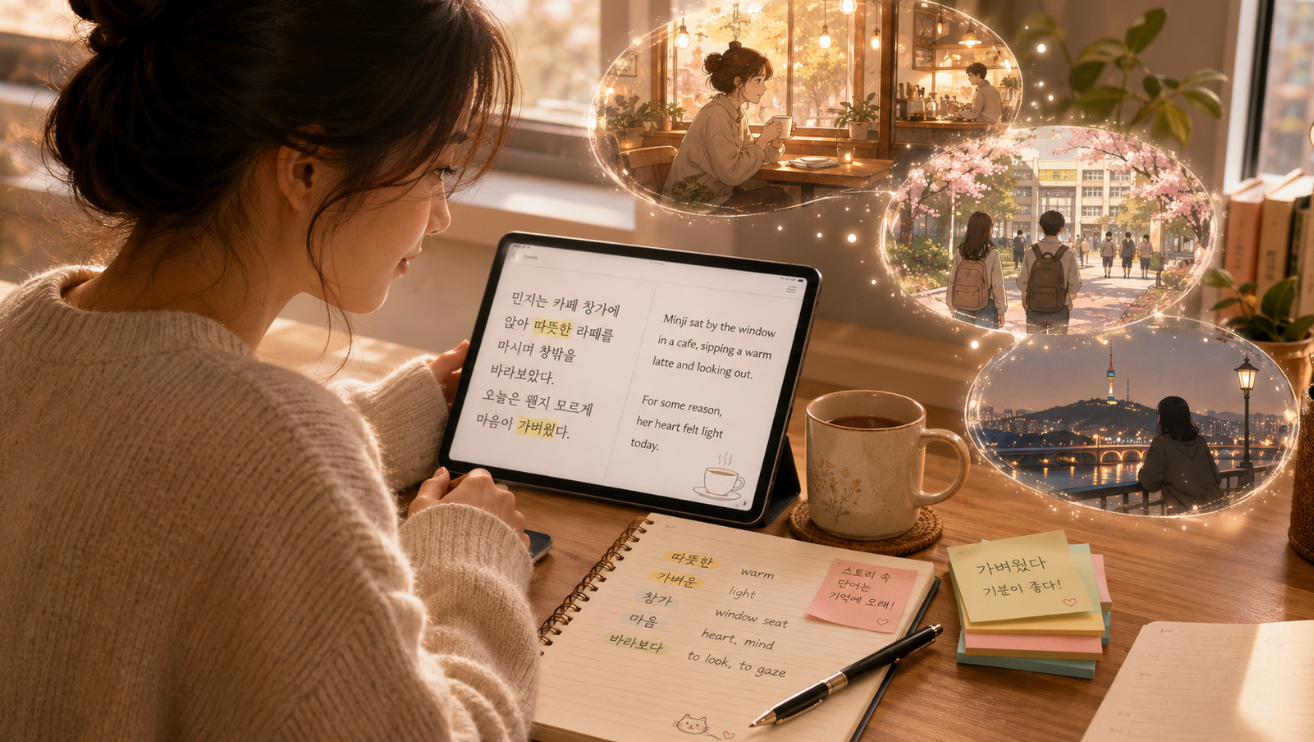
Stories also show how words are actually used. Many Korean words do not match English or other languages perfectly. A simple dictionary translation may not explain the full feeling. Some Korean expressions depend on tone, relationship, age, politeness, or social context. Fiction allows learners to see these words in natural situations. You can observe who says the expression, who listens to it, and what kind of relationship they have.
Another reason stories help vocabulary learning is repetition. In a well-written story, important words appear more than once. A character may “hesitate,” “smile awkwardly,” “reply late,” or “feel relieved” several times in different scenes. Each time you meet the same word again, your memory becomes stronger. The best part is that this repetition does not feel boring because the story continues to move forward.
This is different from memorizing isolated words. If you repeat a flashcard ten times, it can feel mechanical. But if the same Korean word appears in three different story scenes, your brain receives richer information. You learn the meaning, the mood, the grammar pattern, and the situation together. That kind of learning is deeper and more natural.
Stories are also helpful because they teach word combinations, not just single words. In real Korean, words often appear in common patterns. Learners need to know not only the meaning of a word, but also which words usually come before and after it. Through fiction, learners can naturally absorb phrases, sentence endings, dialogue patterns, and everyday expressions.
For example, instead of only memorizing the word “생각하다,” meaning “to think,” a learner may see sentences like “잠시 생각했다,” “그렇게 생각하지 않았다,” or “생각보다 괜찮았다.” These patterns are much more useful than the word alone. Fiction helps learners understand how Korean words live inside sentences.
This is especially important for learners who are interested in Korean culture. Many Korean words are connected to daily life: school, work, family, friendship, dating, cafes, convenience stores, group chats, public transportation, and social pressure. A story can introduce these words naturally. Learners do not just memorize vocabulary. They learn the culture around the vocabulary.
A good way to study is to read a short Korean story first for enjoyment. Do not stop at every unknown word. Try to understand the main scene. Then check the translation in your own language. After that, return to the Korean text and choose five to ten words that appear important or emotionally interesting. Read the sentences containing those words again. This method makes vocabulary learning feel less like work and more like discovery.
If you want to build Korean vocabulary faster, do not only memorize words. Meet them inside stories. Follow the characters, feel the scenes, and let the words appear again and again. That is how Korean vocabulary becomes more than something to remember. It becomes something you understand, recognize, and feel.
'k-fiction' 카테고리의 다른 글
| How Bilingual Reading Builds Confidence in Korean (0) | 2026.06.26 |
|---|---|
| Why K-Fiction Is Different from Textbook Korean (0) | 2026.06.26 |
| Learning Korean Culture Through Everyday Fiction (0) | 2026.06.26 |
| Why Repeated Reading Makes Korean Feel Natural (0) | 2026.06.26 |
| Why Fiction Is One of the Best Ways to Learn Korean (0) | 2026.06.26 |