Many people become interested in Korea through K-pop, K-dramas, movies, food, fashion, or travel videos. These forms of culture are exciting and easy to enjoy, but they often show only the visible side of Korea. To understand a language more deeply, learners need something more personal: everyday life. This is where fiction becomes a powerful tool.
Everyday fiction can show small cultural details that are difficult to explain in a textbook. A short story about a student, a cafe worker, an office employee, a college freshman, or a person riding the subway can reveal how Korean people speak, think, react, and build relationships in daily situations. These ordinary scenes may look simple, but they are full of cultural meaning.
For Korean learners, this matters because language and culture are deeply connected. Korean is not just about vocabulary and grammar. It is also about politeness, age, social distance, emotional tone, and relationship. A sentence can change depending on who is speaking, who is listening, and how close they are. Fiction gives learners a natural way to observe these changes.
For example, a character may speak politely to a teacher, casually to a close friend, carefully to a new coworker, and warmly to a younger sibling. The grammar may look similar at first, but the feeling is different. Through stories, learners can see how Korean language changes across relationships. This helps them understand not only what a sentence means, but also why it sounds natural in that moment.
Everyday fiction also introduces cultural spaces. Many Korean stories include schools, convenience stores, cafes, subway stations, small apartments, office buildings, restaurants, and family homes. These places are not just backgrounds. They shape the way characters behave. A conversation at school may feel different from a conversation at work. A late-night convenience store scene may show loneliness, comfort, humor, or friendship. A cafe scene may show quiet reflection, dating culture, or study habits.
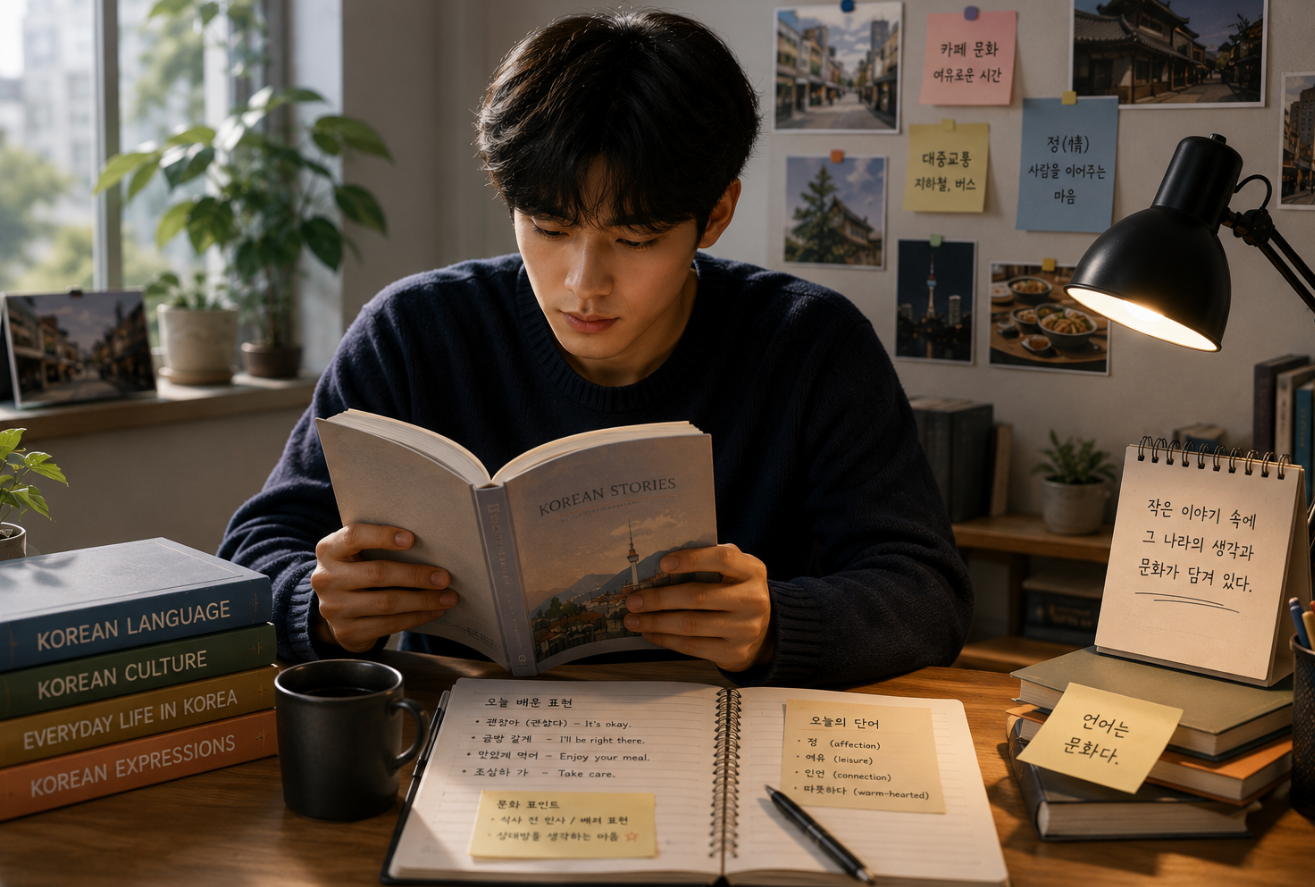
These cultural details help learners build a more realistic image of Korea. Instead of seeing Korea only through dramatic scenes or famous tourist places, they can experience the rhythm of ordinary life. They can learn how people greet each other, how they send messages, how they apologize, how they avoid awkward situations, and how they show care indirectly.
This is especially useful for learners who want to understand modern Korean culture. Younger generations often communicate through a mix of spoken language, texting style, humor, short reactions, emotional expressions, and social media habits. A textbook may teach standard Korean, but everyday fiction can show how people actually express themselves in relaxed and realistic situations.
Stories also make culture easier to remember. If someone simply explains that Korean people often consider age and hierarchy in conversation, the idea may feel abstract. But if a story shows a younger employee hesitating before speaking to a senior coworker, the learner understands the feeling immediately. The cultural rule becomes part of a scene, not just a fact.
Another advantage of fiction is emotional understanding. Culture is not only about rules. It is about feelings. Why does a character stay quiet instead of saying what they really think? Why does someone say “괜찮아” even when they are not completely fine? Why does a small message feel meaningful? Fiction allows learners to explore these subtle emotional layers.
For language learning, this emotional layer is extremely valuable. When learners understand the culture behind a phrase, they remember the phrase more naturally. A word connected to a character’s feeling becomes easier to recall. A sentence connected to a social situation becomes easier to use correctly. Culture gives language depth.
Bilingual reading can make this process even stronger. When learners read the Korean original and compare it with a translation in their own language, they can notice what is easy to translate and what is difficult. Some Korean expressions may have no perfect equivalent. That gap itself becomes a learning moment. Learners begin to understand that language carries culture, not just information.
Learning Korean through everyday fiction is powerful because it feels human. It does not separate language from life. It shows Korean as something people use to laugh, hesitate, comfort, confess, argue, dream, and connect. When learners read these stories, they are not only studying Korean. They are slowly learning how Korean life feels from the inside.
That is why everyday fiction can be one of the best ways to understand Korean culture. It turns ordinary scenes into meaningful lessons, and it turns language learning into a cultural experience.
'k-fiction' 카테고리의 다른 글
| How Bilingual Reading Builds Confidence in Korean (0) | 2026.06.26 |
|---|---|
| Why K-Fiction Is Different from Textbook Korean (0) | 2026.06.26 |
| How Stories Help You Memorize Korean Words Faster (0) | 2026.06.26 |
| Why Repeated Reading Makes Korean Feel Natural (0) | 2026.06.26 |
| Why Fiction Is One of the Best Ways to Learn Korean (0) | 2026.06.26 |