k-story-lessons/B1

The Seven-Second Melody

k-fiction.com 2026. 8. 18. 00:50

What You Will Learn

  • School broadcasting, music, recording, and teamwork vocabulary
  • Expressions used when suggesting, recording, and improving an idea
  • -아/어 보니, -(으)ㄹ수록, and -도록
  • Korean school broadcasting clubs, lunchtime announcements, and basic copyright awareness when making original audio

Korean Story

7초짜리 멜로디

해인은 서울의 한 고등학교에 다니는 2학년 학생이었다.

해인은 음악을 아주 잘하는 학생은 아니었다.

피아노도 칠 줄 몰랐고 노래를 부를 때 높은 음이 나오면 자신이 없었다.

하지만 목소리가 또렷했고 계획을 세우는 것을 좋아했다.

그래서 1학년 때부터 학교 방송부에서 활동하고 있었다.

방송부는 매일 아침과 점심시간에 학교 방송을 준비했다.

학생들에게 필요한 공지를 읽기도 하고, 학교 행사 일정을 소개하기도 했다.

시험 기간에는 공부 방법이나 도서관 이용 시간을 안내했고, 축제 기간에는 공연 순서도 방송했다.

해인의 역할은 주로 원고를 정리하고 방송 순서를 확인하는 일이었다.

마이크 앞에서 직접 공지를 읽는 날도 있었다.

“오늘 점심시간에는 학생회 회의가 있습니다.”

“방과 후 체육관 사용 시간이 변경되었습니다.”

처음에는 마이크를 켜는 것만으로도 긴장했다.

하지만 1년 넘게 활동하다 보니 이제는 방송실이 두 번째 교실처럼 편해졌다.

어느 월요일 점심시간이었다.

방송부 담당 선생님이 학생들을 불렀다.

“이번 학기에는 점심 방송을 조금 바꿔 보면 어떨까요?”

방송부 학생 다섯 명이 작은 회의 테이블에 앉았다.

3학년 방송부장인 준석이 물었다.

“어떤 부분을 바꾸면 좋을까요?”

선생님은 컴퓨터에서 지난주 방송 파일을 재생했다.

먼저 짧은 안내음이 나오고, 바로 학생의 목소리가 이어졌다.

안내음은 학교가 오래전부터 사용하던 단순한 전자음이었다.

삐-삐-삐.

해인은 매일 듣던 소리라 특별하게 생각한 적이 없었다.

선생님이 말했다.

“이 소리를 거의 10년 동안 사용했다고 하네요.”

“10년이요?”

한 학생이 놀랐다.

“여러분이 초등학생일 때부터 사용한 소리인 셈이죠.”

준석이 웃었다.

“그러면 이제 바꿀 때가 된 것 같네요.”

선생님도 웃었다.

“학교 공식 수업 종을 바꾸자는 건 아니에요. 점심 방송을 시작할 때만 나오는 짧은 소리를 새로 만들어 보면 어떨까 합니다.”

해인이 물었다.

“저희가 직접 만드는 건가요?”

“가능하다면요.”

방송부 학생들은 서로를 바라보았다.

방송 원고를 쓰고 음량을 조절하는 일은 익숙했다.

하지만 멜로디를 직접 만드는 일은 해 본 적이 없었다.

선생님은 조건을 설명했다.

“길이는 10초를 넘지 않았으면 좋겠어요.”

“왜 그렇게 짧아야 해요?”

“매일 반복해서 듣는 소리니까 너무 길면 불편할 수 있거든요.”

그리고 한 가지 조건이 더 있었다.

“기존 노래나 유명한 멜로디를 가져오면 안 됩니다.”

해인이 고개를 끄덕였다.

“저작권 때문이죠?”

“맞아요. 학교에서 사용하는 방송이라고 해도 다른 사람이 만든 음악을 마음대로 사용할 수는 없어요.”

선생님은 기존 음악을 조금 바꾸는 것보다 처음부터 새로운 멜로디를 만드는 것이 가장 좋다고 설명했다.

“짧아도 우리 학교 학생들이 직접 만든 소리라면 더 의미가 있겠죠.”

준석은 공책을 펴고 조건을 적었다.

길이: 10초 이하
학생이 직접 만든 멜로디
기존 노래 사용 금지
너무 크거나 자극적인 소리 피하기
방송 시작을 자연스럽게 알릴 수 있을 것

회의가 끝난 뒤 각자 아이디어를 생각해 보기로 했다.

하지만 해인에게는 문제가 있었다.

“멜로디를 어떻게 만들지?”

해인은 음악 수업에서 기본적인 음표를 배운 적은 있었다.

도, 레, 미 정도는 알았다.

하지만 직접 곡을 만든 적은 한 번도 없었다.

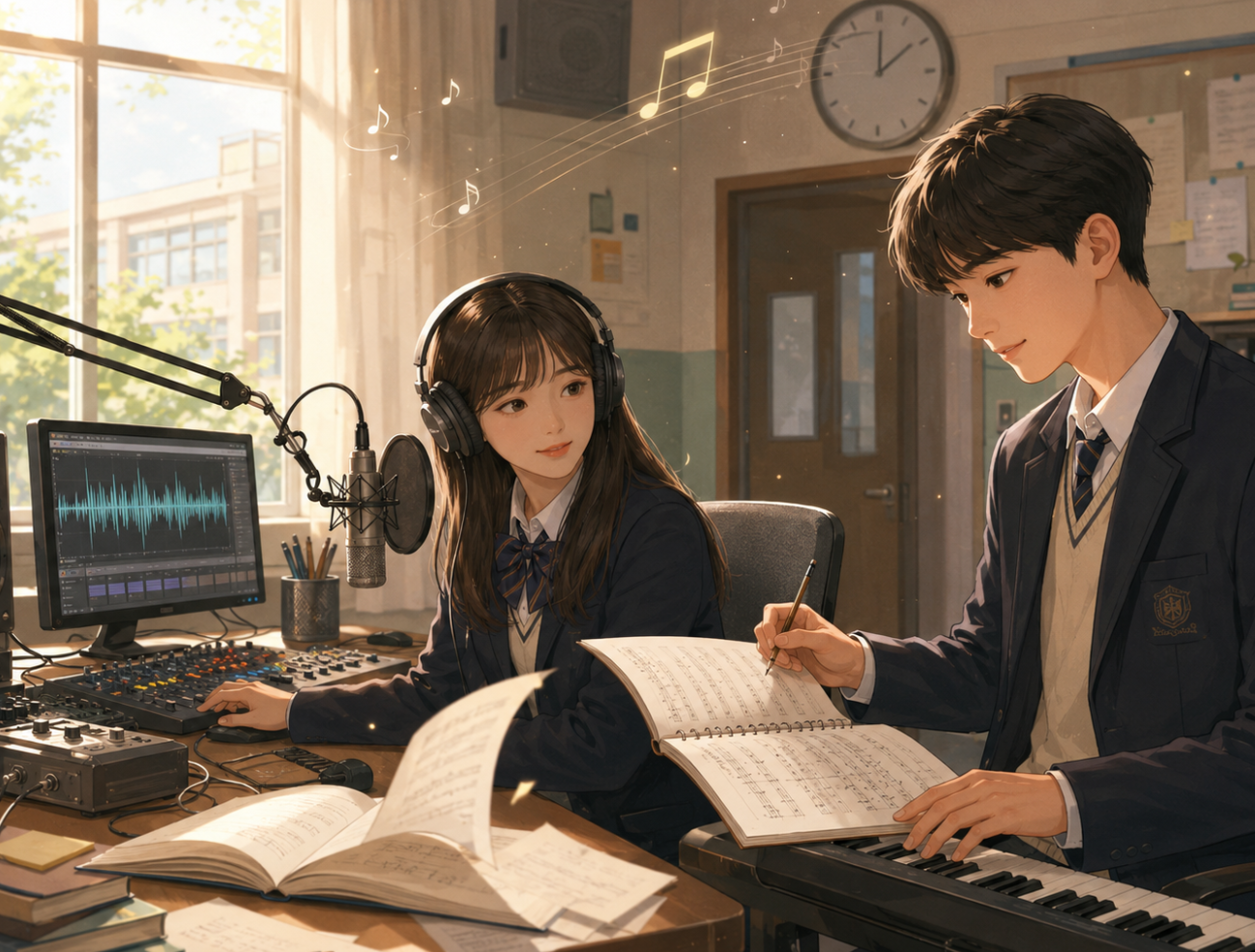
방과 후 해인은 방송실 컴퓨터 앞에 앉아 있었다.

인터넷에서 무료 음악을 찾을 수도 있었지만 선생님의 말을 떠올렸다.

이번에는 학생들이 직접 만든 것이 필요했다.

해인은 책상 위의 연필을 손가락으로 두드렸다.

톡, 톡, 톡.

옆에 있던 준석이 말했다.

“그 소리도 괜찮은데?”

“연필 소리요?”

“응. 방송 시작 전에 톡톡 소리가 나면 재미있을 것 같아.”

해인은 다시 연필을 두드려 보았다.

톡, 톡, 톡.

하지만 방송 안내음이라기보다는 누군가 책상을 두드리는 소리처럼 들렸다.

“이것만 사용하기는 좀 이상해요.”

“멜로디가 하나 있으면 좋겠지.”

준석도 음악을 만들 줄 몰랐다.

다른 방송부원 역시 상황은 비슷했다.

“학교에 음악 잘하는 학생을 찾아봐야 하나?”

해인이 말했다.

“음악 동아리에 물어보자.”

방송부는 다음 날 음악 동아리에 도움을 요청하기로 했다.

하지만 화요일 오후, 예상하지 못한 일이 생겼다.

해인은 방송 원고를 인쇄하러 교무실에 갔다가 음악실 앞을 지나고 있었다.

음악실 문은 조금 열려 있었다.

안에서 피아노 소리가 들렸다.

처음 듣는 멜로디였다.

매우 짧았다.

따라라, 딴.

몇 초 만에 끝났다.

그리고 다시 같은 음이 반복되었다.

따라라, 딴.

해인은 걸음을 멈췄다.

유명한 노래 같지는 않았다.

단순했지만 이상하게 귀에 남았다.

해인은 문을 두드렸다.

“들어가도 돼?”

피아노 앞에 앉아 있던 학생이 뒤를 돌아보았다.

같은 학년의 윤도현이었다.

도현은 해인과 같은 반은 아니었지만 얼굴은 알고 있었다.

“어, 안녕.”

“혼자 연습하고 있었어?”

“응. 음악 수행평가 준비 중이야.”

도현의 앞에는 작은 악보 노트가 펼쳐져 있었다.

해인은 조심스럽게 물었다.

“방금 친 거 무슨 곡이야?”

도현이 조금 민망한 표정을 지었다.

“곡이라고 할 정도는 아니야.”

“그래도 처음 듣는 멜로디인데.”

“내가 그냥 만든 거야.”

해인의 눈이 커졌다.

“직접?”

“응. 네 마디 정도 만들다가 아직 못 끝냈어.”

“다시 한번 쳐 줄 수 있어?”

도현은 건반 위에 손을 올렸다.

따라라, 딴.

이번에도 약 5초 정도였다.

해인은 멜로디가 끝난 뒤 말했다.

“이거 방송 시작할 때 사용하면 잘 어울릴 것 같은데.”

도현이 해인을 바라보았다.

“방송?”

해인은 점심 방송 안내음을 새로 만들고 있다는 이야기를 설명했다.

“10초보다 짧아야 하고 완전히 새로운 멜로디여야 해.”

도현은 잠시 생각했다.

“이건 진짜 그냥 연습하다가 만든 건데.”

“그래서 더 좋은 것 같아.”

“너무 단순하지 않아?”

“매일 듣는 소리는 복잡하지 않은 게 더 좋을 수도 있어.”

도현은 악보를 바라보았다.

“그래도 지금 그대로 쓰기는 조금 이상할 것 같아.”

“같이 바꿔 보면 안 될까?”

“같이?”

해인은 피아노를 칠 줄 모른다고 솔직하게 말했다.

“나는 음악은 잘 모르지만 방송에서 소리가 어떻게 들리는지는 조금 알아.”

도현은 웃었다.

“그럼 서로 아는 게 다르네.”

“그래서 같이 하면 되지.”

도현은 다음 날 방송실에 와 보기로 했다.

수요일 점심시간, 도현은 방송실 문 앞에 나타났다.

손에는 작은 악보 노트가 있었다.

“여기 처음 들어와 봐.”

도현은 방송실 안을 둘러보았다.

마이크, 컴퓨터, 오디오 장비와 여러 개의 케이블이 놓여 있었다.

해인이 말했다.

“나는 음악실이 낯설고 너는 방송실이 낯설네.”

준석도 도현에게 인사했다.

“멜로디 만든 학생이지?”

도현은 조금 긴장한 표정으로 고개를 끄덕였다.

해인은 휴대전화로 녹음한 피아노 소리를 재생했다.

따라라, 딴.

준석이 말했다.

“짧아서 좋다.”

다른 부원도 고개를 끄덕였다.

“처음 세 음이 밝게 올라가고 마지막에 딱 끝나는 느낌이 있어서 방송 시작하고 잘 어울릴 것 같아.”

하지만 문제가 하나 있었다.

피아노로만 연주하니 소리가 조금 차분했다.

점심시간의 시작을 알리기에는 약간 힘이 부족했다.

도현이 말했다.

“마지막 음을 조금 높게 바꿔 볼까?”

해인은 고개를 저었다.

“마지막이 너무 높으면 방송 목소리가 바로 나올 때 조금 시끄럽게 느껴질 수도 있어.”

도현은 새로운 음을 몇 개 연주했다.

첫 번째 버전은 너무 밝았다.

두 번째는 약간 슬프게 들렸다.

세 번째는 처음보다 길었다.

여러 가지를 들어 볼수록 처음 만든 멜로디가 가장 자연스럽게 느껴졌다.

해인이 웃었다.

“이상하다. 바꿀수록 처음 게 더 좋아 보여.”

도현도 웃었다.

“나도 그래.”

준석이 말했다.

“그러면 멜로디는 그대로 두고 다른 소리를 아주 조금 추가하는 건 어때?”

해인은 전날 연필을 두드렸던 일을 떠올렸다.

“학교에서 나는 소리를 넣어 보면 어떨까요?”

“학교에서 나는 소리?”

도현이 물었다.

“예를 들면 책 넘기는 소리나 연필 놓는 소리 같은 거.”

준석이 말했다.

“재미있는데?”

학생들은 방송실 안에서 직접 소리를 녹음해 보기로 했다.

먼저 책 한 권을 준비했다.

해인이 마이크 가까이에서 페이지를 넘겼다.

사락.

컴퓨터에서 녹음된 소리를 들어 보았다.

생각보다 크게 들렸다.

“책 소리가 이렇게 크구나.”

해인이 놀랐다.

도현은 웃었다.

“마이크가 가까우니까.”

두 번째로 연필을 책상 위에 놓는 소리를 녹음했다.

톡.

세 번째는 연필 세 자루를 서로 가볍게 부딪쳤다.

딱, 딱.

하지만 이 소리는 조금 날카롭게 들렸다.

“이건 빼자.”

해인이 말했다.

“매일 듣기에는 귀가 피곤할 것 같아.”

도현이 말했다.

“책 넘기는 소리가 제일 좋은 것 같아.”

결국 피아노 멜로디 앞에 아주 작은 책장 넘기는 소리를 넣어 보기로 했다.

구성은 단순했다.

책장 넘기는 소리 — 약 1초
피아노 멜로디 — 약 5초
마지막 여운 — 약 1초

전체 길이는 7초 정도였다.

“7초네.”

도현이 말했다.

준석이 파일 이름을 입력했다.

lunch_intro_test_01

해인은 파일을 처음부터 다시 재생했다.

사락.

따라라, 딴.

이번에는 느낌이 조금 달랐다.

짧은 이야기가 시작되는 것 같기도 했다.

“좋은데?”

준석이 말했다.

하지만 방송실 스피커와 교실 스피커는 소리가 다르게 들릴 수 있었다.

작은 컴퓨터 스피커에서는 괜찮아도 학교 전체 방송에서는 너무 크게 들릴 수도 있었다.

목요일 방과 후, 방송부는 빈 교실을 이용해 테스트하기로 했다.

학생들이 모두 집에 간 뒤 2학년 3반 교실에서 소리를 재생했다.

해인은 교실 가운데에 서 있었다.

준석은 방송실에서 파일을 재생했다.

사락.

따라라, 딴.

해인은 바로 방송실로 전화했다.

“조금 커요.”

“어느 부분?”

“책 넘기는 소리요. 생각보다 너무 크게 들려요.”

준석은 음량을 낮췄다.

다시 재생했다.

이번에는 피아노의 첫 음이 너무 작았다.

세 번째 테스트에서는 전체 소리를 조금 높였다.

네 번째에는 마지막 음을 조금 줄였다.

계속 조정하다 보니 30분이 지나갔다.

도현이 말했다.

“음 하나 만드는 데 이렇게 오래 걸릴 줄 몰랐어.”

해인이 대답했다.

“방송도 비슷해. 20초짜리 안내 방송을 위해 원고를 여러 번 고칠 때도 있어.”

다섯 번째 테스트를 했을 때 세 사람은 동시에 고개를 끄덕였다.

책 소리는 아주 작게 들렸다.

그 뒤에 피아노 멜로디가 자연스럽게 이어졌다.

마지막 음이 사라진 뒤 약 0.5초 동안 조용한 시간이 있었다.

그 다음에 바로 방송 원고가 시작될 수 있었다.

“이 정도면 괜찮겠다.”

해인이 말했다.

도현도 만족스러운 표정이었다.

하지만 담당 선생님은 바로 사용하지 말고 학생들의 의견을 조금 들어 보자고 했다.

“만든 사람들만 계속 듣다 보면 객관적으로 판단하기 어려울 수 있어요.”

다음 날 점심시간에 방송부는 학생 열 명에게 두 가지 안내음을 들려주었다.

기존 전자음과 새로 만든 7초짜리 멜로디였다.

어떤 소리가 더 좋았는지, 너무 크거나 불편한 부분은 없는지 간단하게 물었다.

대부분의 학생이 새로운 멜로디를 선택했다.

“소리가 부드러워서 좋아요.”

“방송이 시작된다는 느낌이 들어요.”

“책 넘기는 소리가 재미있어요.”

하지만 한 학생은 말했다.

“처음에 책 소리인지 잘 모르겠어요.”

다른 학생도 비슷한 의견이었다.

“바람 소리처럼 들려요.”

해인은 조금 아쉬웠다.

자신들이 알고 들으면 책장 소리였지만, 처음 듣는 사람에게는 다른 소리처럼 들릴 수 있었다.

도현이 말했다.

“조금 더 크게 만들면 책 소리라는 걸 알 수 있지 않을까?”

해인은 전날 교실 테스트를 떠올렸다.

“그러면 또 너무 크게 들릴 수 있어.”

준석이 말했다.

“꼭 책 소리라고 알아야 할까?”

두 사람은 준석을 바라보았다.

“듣는 사람이 정확히 무엇인지 몰라도 부드럽게 시작하는 소리면 역할은 하는 거잖아.”

해인은 잠시 생각했다.

맞는 말이었다.

모든 요소를 설명해야 좋은 소리가 되는 것은 아니었다.

도현도 동의했다.

“그럼 지금 정도로 두자.”

금요일 오후, 학생들은 최종 파일을 담당 선생님에게 제출했다.

선생님은 이어폰으로 두 번 들었다.

“처음보다 훨씬 자연스러워졌네요.”

“월요일부터 사용해도 될까요?”

해인이 물었다.

선생님이 말했다.

“한 가지 확인할 게 있어요.”

학생들은 긴장했다.

“피아노 멜로디는 도현 학생이 직접 만든 게 맞죠?”

“네.”

“책 넘기는 소리도 여러분이 직접 녹음했고요?”

“네.”

“외부 음원이나 다른 음악은 사용하지 않았나요?”

“전혀 사용하지 않았습니다.”

선생님은 고개를 끄덕였다.

“그러면 제작 과정도 기록해 두세요.”

해인이 물었다.

“왜 기록이 필요해요?”

“나중에 누가 만든 음원인지 확인할 필요가 생길 수도 있고, 후배 방송부에게도 도움이 되니까요.”

학생들은 간단한 제작 기록을 만들었다.

제목: 점심 방송 시작음
길이: 약 7초
멜로디: 학생이 직접 작곡
연주: 교내 피아노로 직접 녹음
효과음: 책장 넘기는 소리를 직접 녹음
외부 음악 및 음원 사용 없음
제작: 방송부 학생들과 참여 학생

도현은 기록을 읽으며 말했다.

“내가 만든 몇 초짜리 멜로디가 이렇게 공식적인 자료가 될 줄 몰랐네.”

해인이 웃었다.

“이제 도망갈 수 없어.”

“왜?”

“학교에서 매일 네 멜로디가 나오잖아.”

“갑자기 부담되는데?”

“이미 늦었어.”

두 사람은 웃었다.

월요일이 되었다.

점심시간 5분 전, 해인은 방송실에 들어갔다.

오늘은 자신이 직접 첫 방송을 진행하기로 했다.

컴퓨터 화면에는 새로운 파일이 준비되어 있었다.

해인은 마이크 음량을 확인했다.

준석이 말했다.

“긴장돼?”

“조금.”

“평소 방송이랑 똑같아.”

“평소에는 학교 전체가 처음 듣는 소리를 틀지 않잖아요.”

12시 40분이 되었다.

해인은 재생 버튼을 눌렀다.

학교 전체 스피커에서 소리가 나왔다.

사락.

따라라, 딴.

7초가 지나갔다.

해인은 마이크를 켰다.

“안녕하세요. 점심 방송을 시작합니다.”

평소와 똑같은 문장이었다.

하지만 해인에게는 조금 다르게 느껴졌다.

첫 번째 안내를 읽는 동안에도 자신들이 만든 멜로디가 머릿속에 남아 있었다.

방송이 끝난 뒤 해인은 복도로 나왔다.

학생들이 급식실로 이동하고 있었다.

두 학생이 앞에서 이야기하는 소리가 들렸다.

“아까 방송 소리 바뀌었지?”

“응. 처음 듣는 소리였어.”

“괜찮던데?”

해인은 자신도 모르게 미소를 지었다.

계단에서 도현을 만났다.

도현도 급식실로 가는 중이었다.

“들었어?”

해인이 물었다.

“당연하지.”

“어땠어?”

“이상했어.”

해인의 표정이 조금 굳었다.

“별로였어?”

“아니.”

도현이 웃었다.

“음악실에서 혼자 치던 게 학교 전체에서 나오니까 이상했다고.”

“나도 비슷했어.”

두 사람은 함께 급식실로 걸었다.

그날 오후에는 예상보다 많은 학생이 방송부에 새로운 안내음에 대해 물었다.

“무슨 노래예요?”

“어디에서 찾았어요?”

“제목이 있어요?”

해인은 같은 대답을 여러 번 했다.

“학교 학생이 직접 만든 멜로디예요.”

누군가는 놀랐고 누군가는 도현이 누구인지 물었다.

하지만 도현은 자신의 이름을 크게 알리고 싶어 하지 않았다.

“그냥 방송부 학생들이 만들었다고 하면 안 될까?”

해인은 도현의 생각을 존중했다.

방송부는 학교 게시판에 짧은 안내문을 올렸다.

이번 학기부터 점심 방송 시작음이 변경되었습니다.
새로운 시작음은 학생들이 직접 작곡·연주·녹음한 오리지널 음원입니다.

개인 이름은 적지 않았다.

일주일 정도 지나자 학생들은 새로운 소리에 익숙해졌다.

처음 며칠은 “방송 소리가 바뀌었다”는 이야기가 나왔지만, 그다음부터는 별다른 반응이 없었다.

해인은 오히려 그것이 성공이라고 생각했다.

매일 듣는 소리는 지나치게 눈에 띄지 않는 것이 좋았다.

자연스럽게 방송의 시작을 알려 주면 충분했다.

하지만 이상한 변화가 하나 생겼다.

해인은 점심시간이 되면 복도에서도 그 멜로디를 기다리게 되었다.

사락.

따라라, 딴.

7초밖에 되지 않았지만, 그 소리를 들으면 오전 수업이 끝났다는 느낌이 들었다.

학생들이 책을 덮었다.

의자를 움직였다.

친구들과 급식 메뉴 이야기를 했다.

조용했던 복도도 갑자기 활발해졌다.

어느 날 도현이 말했다.

“처음에는 그냥 음 네 개였는데.”

“응.”

“계속 듣다 보니까 점심시간 느낌이 나.”

해인도 같은 생각이었다.

“소리 자체는 똑같은데 듣는 상황이 계속 쌓이는 것 같아.”

“그게 무슨 뜻이야?”

“오늘 들으면 오늘 점심시간이 생각나고, 내일 들으면 또 내일 기억이 생기는 거지.”

도현은 웃었다.

“방송부에서는 그런 것도 생각해?”

“지금 처음 생각했어.”

도현은 악보 노트를 꺼냈다.

첫날 음악실에서 보여 준 페이지였다.

네 개의 음이 연필로 적혀 있었다.

그 옆에는 지운 흔적도 많았다.

“이건 아직 가지고 있네.”

해인이 말했다.

“버리기 아까워서.”

“학교 기록실에 기부해.”

“그 정도로 중요한 건 아니야.”

하지만 도현은 페이지를 사진으로 찍어 두었다.

시간이 지나면서 방송부 학생들도 조금씩 새로운 아이디어를 내기 시작했다.

“학교 축제 방송에는 다른 시작음을 만들면 어때요?”

“졸업식 안내 방송도 특별하게 만들 수 있겠네요.”

담당 선생님은 좋은 생각이지만 모든 소리를 바꿀 필요는 없다고 말했다.

“새로운 것이 많다고 항상 좋은 것은 아니에요.”

선생님은 학생들에게 중요한 기준을 세 가지 알려 주었다.

첫째, 왜 필요한지 생각할 것.

둘째, 다른 사람의 음악이나 효과음을 허락 없이 사용하지 않을 것.

셋째, 반복해서 들어도 불편하지 않은지 확인할 것.

해인은 이 세 가지를 방송실 화이트보드에 적어 두었다.

몇 주 뒤 학교 축제 준비가 시작되었다.

방송부에서는 축제 안내 방송을 만들었다.

이번에는 도현뿐 아니라 음악 동아리 학생 세 명도 참여했다.

하지만 기존의 7초 멜로디를 길게 늘리지는 않았다.

대신 축제용으로 완전히 새로운 짧은 리듬을 만들었다.

해인은 제작 과정을 정리했다.

누가 어떤 소리를 만들었는지 기록했다.

모든 음은 학생들이 직접 연주하고 녹음했다.

작업을 여러 번 해 볼수록 해인은 처음보다 판단이 빨라졌다.

“이 소리는 너무 커.”

“여기는 안내 멘트하고 겹쳐.”

“처음 1초가 너무 길어.”

도현도 작곡할 때 방송 환경을 더 많이 생각하게 되었다.

“좋은 멜로디만 만들면 되는 줄 알았는데.”

“방송에서는 어디에서 어떻게 들리는지도 중요하지.”

“그러니까 음악실에서 좋은 소리가 교실에서는 이상할 수도 있는 거네.”

“맞아.”

함께 작업할수록 두 사람은 서로의 역할을 더 잘 이해하게 되었다.

해인은 음 하나를 바꾸는 것이 분위기를 크게 바꿀 수 있다는 것을 배웠다.

도현은 1초의 조용한 시간도 방송에서는 중요한 부분이 될 수 있다는 것을 알게 되었다.

어느 금요일 방과 후, 두 사람은 처음 작업했던 빈 교실에 다시 갔다.

축제용 소리를 테스트하기 위해서였다.

테스트를 마친 뒤 도현이 말했다.

“여기 기억나?”

“당연하지.”

“우리가 책 소리 때문에 다섯 번이나 다시 들었던 곳.”

“다섯 번이 아니라 일곱 번쯤 했을걸?”

“그렇게 많이 했어?”

“그래서 7초짜리 소리가 완성된 거야.”

도현은 웃었다.

교실 스피커에서는 아무 소리도 나오지 않았다.

창밖에서는 운동장에서 공을 차는 학생들의 목소리가 들렸다.

도현이 말했다.

“내년에 우리가 3학년이 되어도 이 소리는 계속 쓰겠지?”

“아마.”

“졸업한 뒤에도?”

해인은 잠시 생각했다.

“후배들이 마음에 들어 하면 계속 사용하고, 새로운 걸 만들고 싶으면 바꾸겠지.”

“조금 아쉽겠다.”

“왜?”

“학교에서 내 소리가 사라지는 거잖아.”

해인은 도현을 바라보았다.

처음 벽화를 그리거나 물건을 남기는 것처럼 눈에 보이는 것도 아니었다.

소리는 재생하지 않으면 아무것도 남지 않았다.

하지만 해인은 말했다.

“바뀌어도 괜찮지 않을까?”

“왜?”

“우리가 만들었다는 사실까지 없어지는 건 아니니까.”

도현은 잠시 아무 말도 하지 않았다.

그러고는 고개를 끄덕였다.

“그건 그렇네.”

2학기가 시작되고 시간이 빠르게 지나갔다.

11월이 되자 아침 공기가 차가워졌다.

교실 창문에는 가끔 하얀 김이 생겼다.

학생들은 두꺼운 외투를 입고 학교에 왔다.

점심시간에는 여전히 같은 7초 멜로디가 흘러나왔다.

사락.

따라라, 딴.

이제 대부분의 학생은 특별히 주의해서 듣지 않았다.

하지만 어느 날 해인은 예상하지 못한 이야기를 들었다.

1학년 학생 한 명이 방송실에 찾아왔다.

“저 방송부 지원하려고 하는데요.”

해인이 말했다.

“다음 학기 모집은 아직 조금 남았어요.”

“알아요. 그냥 궁금한 게 있어서요.”

학생은 점심 방송 시작음에 대해 물었다.

“그 음악 방송부에서 만든 거 맞아요?”

“응.”

“저 그 소리 듣고 방송부에 관심이 생겼어요.”

해인은 놀랐다.

“정말?”

“처음에는 어디에서 나온 음악인지 궁금했어요. 그런데 학생들이 직접 만들었다는 안내문을 봤어요.”

학생은 컴퓨터로 소리를 만드는 일에 관심이 있다고 했다.

집에서도 자신이 직접 짧은 효과음을 만들어 본다고 했다.

“방송부에 들어오면 그런 것도 할 수 있어요?”

“할 수 있지.”

해인은 방송부 활동이 단순히 마이크 앞에서 말하는 것만은 아니라고 설명했다.

원고를 쓰는 사람도 필요했다.

음향을 조절하는 사람도 필요했다.

행사를 기록하거나 방송 파일을 정리하는 역할도 있었다.

“음악을 잘해야 하나요?”

학생이 물었다.

“전혀.”

해인은 웃으며 말했다.

“나도 피아노 못 쳐.”

“그런데 이 멜로디 만들었잖아요.”

“나는 음을 만든 게 아니라 방송에 맞게 정리하는 일을 했어.”

해인은 도현과 함께 처음 작업했던 이야기를 짧게 들려주었다.

학생은 흥미롭게 들었다.

“혼자 다 할 필요는 없네요.”

“응. 서로 잘하는 게 다르면 오히려 좋아.”

학생이 돌아간 뒤 해인은 잠시 방송실에 혼자 앉아 있었다.

7초밖에 되지 않는 짧은 소리가 누군가에게 방송부에 관심을 가지게 할 수도 있다는 사실이 신기했다.

다음 날 해인은 도현에게 그 이야기를 했다.

“진짜?”

“응. 네 멜로디 때문에 방송부에 들어오고 싶대.”

“내 멜로디 때문은 아니지.”

“우리가 만든 소리 때문.”

도현은 잠시 웃었다.

“그건 조금 기분 좋다.”

겨울방학이 가까워지자 방송부는 한 해 동안 사용한 파일을 정리했다.

컴퓨터 안에는 수백 개의 방송 파일이 있었다.

행사 안내, 시험 일정, 학생회 공지와 점심 방송 원고가 날짜별로 저장되어 있었다.

해인은 오래된 파일을 삭제하거나 다른 저장 장치로 옮겼다.

그러다가 lunch_intro_test_01이라는 파일을 발견했다.

처음 만든 버전이었다.

현재 사용하는 최종 파일과 비교해 보았다.

처음 버전에서는 책 넘기는 소리가 너무 컸다.

피아노 음량도 일정하지 않았다.

마지막 여운도 조금 길었다.

해인은 혼자 웃었다.

“이걸 좋다고 생각했었네.”

준석이 옆에서 말했다.

“처음에는 다 그런 거야.”

“지울까요?”

“왜 지워?”

“이제 필요 없잖아요.”

준석은 고개를 저었다.

“테스트 파일도 남겨 둬. 후배들이 보면 완성까지 어떻게 바뀌었는지 알 수 있잖아.”

해인은 별도의 폴더를 만들었다.

학생 제작 방송음원
├─ 초기 테스트
├─ 최종 파일
└─ 제작 기록

처음 음악실에서 도현이 만든 네 음.

방송실에서 녹음한 책장 소리.

빈 교실에서 반복한 테스트.

학생들의 의견.

그리고 최종 7초.

과정을 한곳에 모아 보니 짧은 파일 하나가 생각보다 많은 시간을 가지고 있었다.

방학 전 마지막 방송 날이었다.

해인은 점심 방송을 맡았다.

창밖에는 아주 약한 눈이 내리고 있었다.

12시 40분이 되었다.

해인은 평소처럼 재생 버튼을 눌렀다.

사락.

따라라, 딴.

그리고 말했다.

“안녕하세요. 이번 학기 마지막 점심 방송을 시작합니다.”

방송 끝부분에는 겨울방학 일정과 도서관 운영 시간이 안내되었다.

마지막으로 해인이 말했다.

“한 학기 동안 점심 방송을 들어 주셔서 감사합니다. 따뜻한 겨울방학 보내세요.”

마이크를 끈 뒤 방송실 안이 조용해졌다.

준석이 박수를 쳤다.

“수고했다.”

다른 부원들도 웃었다.

학교 복도에서는 학생들이 급식실로 이동하는 소리가 들렸다.

해인은 창문 밖을 바라보았다.

운동장 위로 작은 눈송이가 떨어지고 있었다.

도현에게 메시지가 왔다.

마지막 방송 들었어.

해인이 답했다.

멜로디도 들었지?

이제 안 들리면 점심시간 아닌 것 같을 듯.

해인은 웃었다.

다음 학기에도 나오니까 걱정 마.

잠시 뒤 도현의 답장이 왔다.

처음 만든 4개 음이 이렇게 오래 갈 줄 몰랐다.

해인은 잠시 생각하다가 답했다.

4개 음이 아니라 우리가 만든 7초지.

그리고 한 문장을 더 보냈다.

짧아도 매일 들으면 기억이 되나 봐.

방학이 시작된 첫날, 학교에는 점심 방송이 없었다.

해인은 집에서 늦게 아침을 먹었다.

정오가 조금 지나자 평소 학교에서 멜로디가 나오던 시간이 되었다.

아무 소리도 들리지 않았다.

그런데 이상하게 해인의 머릿속에서 그 멜로디가 자연스럽게 떠올랐다.

사락.

따라라, 딴.

해인은 혼자 웃었다.

7초짜리 소리는 방송실 컴퓨터 안에만 있는 것이 아니었다.

같이 만든 사람들의 기억에도 있었고, 매일 점심을 기다리던 학생들의 하루 속에도 조금씩 들어가 있었다.

그리고 다음 학기가 시작되면 같은 소리는 또 새로운 하루의 시작을 알릴 것이었다.


Natural English Translation

The Seven-Second Melody

Haein was a second-year student at a high school in Seoul.

She was not especially talented at music.

She could not play the piano, and she lost confidence whenever a song became too high.

However, she had a clear speaking voice and enjoyed making plans.

For that reason, she had been a member of the school broadcasting club since her first year.

The club prepared morning and lunchtime announcements every day.

Members read important notices, introduced school events, explained library hours during examination periods, and announced festival schedules.

Haein usually organized scripts and checked the order of each broadcast.

Sometimes she also spoke directly into the microphone.

At first, simply switching on the microphone made her nervous.

After more than a year, however, the broadcasting room had become almost like a second classroom.

One Monday at lunchtime, the teacher responsible for the club called a meeting.

“What if we change part of the lunchtime broadcast this semester?”

Five club members sat around a small table.

The teacher played a recording from the previous week.

A short electronic sound played before the announcement.

Beep, beep, beep.

The school had apparently used the same sound for almost ten years.

The teacher suggested creating a new sound that would be played only before the lunchtime broadcast.

It needed to be less than ten seconds long.

It also needed to be completely original.

The teacher explained that they should not copy a famous song or simply change an existing melody.

Even in a school broadcast, other people’s music could not simply be used without permission.

A short sound created by the students themselves would also be more meaningful.

The students recorded the conditions:

Less than ten seconds
Created by students
No existing songs
No loud or irritating sounds
Must naturally signal the beginning of the broadcast

The problem was that none of the broadcasting-club members knew how to compose music.

Haein considered asking the school music club for help.

The following afternoon, however, something unexpected happened.

While walking past the music room, she heard a short piano melody.

It lasted only a few seconds.

She had never heard it before.

Inside the room was Yoon Dohyeon, another second-year student.

When Haein asked what song he was playing, Dohyeon explained that it was not a song.

He had made the melody himself while practicing.

Haein asked him to play it again.

The simple four-note melody lasted around five seconds.

She immediately thought it might work as the opening sound for the lunchtime broadcast.

Dohyeon was unsure.

It was unfinished and very simple.

Haein explained that a repeated school sound might actually work better if it was simple.

She could not play music, but she understood how sound worked in a broadcast.

Dohyeon understood music but knew nothing about school broadcasting.

Their skills were different.

That was exactly why Haein thought they could work together.

The following day, Dohyeon visited the broadcasting room for the first time.

The club listened to the melody.

Everyone liked its short length and the way the first notes rose before the final note ended clearly.

However, piano alone sounded slightly too calm.

They tried changing several notes.

One version sounded too bright.

Another sounded sad.

A third became too long.

The more versions they tried, the more they liked the original melody.

Instead of changing the notes, the students decided to add a very small sound before the piano.

Haein suggested using sounds recorded at school.

They tried the sound of pencils and other objects.

Some were too sharp or distracting.

Finally, they recorded a page turning.

The structure became simple:

Page-turning sound — about one second
Piano melody — about five seconds
Short final resonance — about one second

The complete sound was approximately seven seconds long.

They tested it in an empty classroom after school.

The first version sounded too loud.

When they lowered the page sound, the piano became too quiet.

They adjusted the volume again and again.

After several tests, they finally found a balance.

The page sound was soft, the piano followed naturally, and a short moment of silence remained before the spoken announcement began.

The teacher suggested asking other students for feedback before using it.

Ten students compared the old electronic sound with the new seven-second melody.

Most preferred the new version.

They said it sounded softer and more natural.

However, several students could not recognize the page-turning sound.

Haein initially felt disappointed.

Dohyeon suggested making it louder.

However, that could make the sound uncomfortable when played through classroom speakers.

Then the broadcasting-club leader asked an important question.

“Does everyone really need to know that it is a page turning?”

The sound could still work even if listeners did not know exactly what it was.

The group decided to keep it subtle.

Before approving the file, the teacher confirmed that Dohyeon had composed the melody himself and that the students had recorded every sound themselves.

No outside music or effects had been used.

The teacher asked them to record the production process as well.

The document listed the length, composition, recording process, and confirmation that no outside audio had been used.

Dohyeon was surprised that something he had casually played in the music room had become an official school file.

On Monday, the new sound was used for the first time.

Haein sat in the broadcasting room.

At 12:40, she pressed the play button.

Across the school speakers came the sound of a page turning.

Then the four-note piano melody.

Seven seconds later, Haein switched on the microphone.

“Hello. We will now begin our lunchtime broadcast.”

It was the same sentence she always used.

However, it felt different that day.

Afterward, Haein heard students discussing the changed sound in the hallway.

They seemed to like it.

She later met Dohyeon on the way to the cafeteria.

He said it felt strange to hear something he had played alone in the music room come from every speaker in the school.

More students asked where the melody had come from.

Some thought it was an existing song.

Haein explained that it was an original sound created by students.

Dohyeon did not want his name widely announced, so the club respected his wishes.

A short notice simply explained that the new sound had been composed, played, and recorded by students.

After about one week, the school became used to the melody.

Students stopped talking about it.

Haein considered this a success.

A sound heard every day did not need to attract attention.

It simply needed to signal the beginning of the broadcast naturally.

However, Haein began noticing something else.

Whenever the melody played, morning classes were over.

Students closed their books.

Chairs moved.

Friends began discussing the lunch menu.

The quiet hallway suddenly became busy.

The melody itself had not changed, but memories were beginning to gather around it.

Dohyeon felt the same way.

At first, it had been only four notes.

Now it felt like lunchtime.

As they continued working together, both students learned from each other.

Haein learned how changing even one note could change the mood.

Dohyeon learned that in broadcasting, even half a second of silence could matter.

A few weeks later, they began preparing new sounds for the school festival.

Instead of extending the original melody, they created something completely new.

They recorded all sounds themselves and carefully documented who created each part.

The more they worked, the easier it became to judge volume, timing, and the relationship between music and spoken announcements.

One afternoon, they returned to the empty classroom where they had tested the first melody.

Dohyeon wondered whether the seven-second sound would continue after they graduated.

Haein said that younger students might continue using it or replace it with something new.

Dohyeon admitted that he might feel disappointed if his melody disappeared.

Haein understood.

However, even if the sound was replaced one day, the fact that they had created it would not disappear.

Dohyeon agreed.

As the semester continued, the melody became an ordinary part of school life.

Then one day, a first-year student visited the broadcasting room.

The student wanted to join the club.

He explained that the seven-second melody had made him curious about how school broadcasts were created.

He was interested in making short sound effects on a computer.

Haein explained that broadcasting was not only about speaking into a microphone.

People were needed to write scripts, adjust sound, organize files, record events, and create audio.

The student asked whether he needed to be good at music.

Haein laughed.

She could not play the piano either.

She had not written the melody.

Her role had been to help shape it for broadcasting.

The student understood that one person did not need to do everything.

Different skills could work together.

After he left, Haein was surprised that such a short sound had encouraged someone to become interested in the broadcasting club.

When she told Dohyeon, he was pleased too.

Near winter vacation, the broadcasting club organized its files.

Hundreds of recordings were stored on the broadcasting-room computer.

Haein found the first test version of their melody.

The page sound was too loud.

The piano volume was uneven.

The ending was slightly too long.

She laughed at how good they had thought it sounded at the time.

She considered deleting it.

However, the club leader told her to keep the test file.

Future students could understand how the final version had developed.

Haein created a folder containing:

Student-Made Broadcast Audio
Initial Tests
Final File
Production Notes

When everything was placed together, the seven-second sound seemed to contain much more time than its actual length.

There were the first four notes in the music room.

The recorded page turn.

The empty classroom tests.

Student feedback.

And finally, the finished sound.

On the final school day before winter vacation, Haein hosted the lunchtime broadcast.

Light snow was falling outside.

At 12:40, she pressed the play button.

A page turned.

The piano melody followed.

Then she switched on the microphone.

“Hello. This is the final lunchtime broadcast of the semester.”

At the end, she thanked everyone for listening and wished them a warm winter vacation.

After turning off the microphone, the room became quiet.

A message from Dohyeon arrived.

I heard the last broadcast.

Haein replied:

You heard the melody too, right?

Dohyeon wrote:

If I don’t hear it now, it won’t feel like lunchtime.

Haein smiled.

He then added:

I never thought the four notes I made would last this long.

Haein answered:

It isn’t only four notes anymore.
It is the seven seconds we made together.

Then she wrote one more sentence.

I think even something short can become a memory if you hear it every day.

On the first day of vacation, there was no school broadcast.

Around noon, Haein realized it was the time when the melody usually played.

The room was silent.

But the sound appeared naturally inside her head.

A turning page.

Four piano notes.

The seven-second melody no longer existed only as a file on a school computer.

It was also inside the memories of the students who had created it and had become a small part of the everyday lives of the students who heard it.

When the next semester began, the same seven seconds would once again signal the beginning of another school day’s lunchtime.


Essential Vocabulary

KoreanRomanizationMeaning

방송부 bangsongbu school broadcasting club
방송실 bangsongshil broadcasting room
안내 방송 annae bangsong announcement
원고 wongo script
마이크 maikeu microphone
음량 eumryang volume
안내음 annae-eum notification sound
멜로디 mellodi melody
작곡하다 jakgokhada to compose
연주하다 yeonjuhada to perform music
녹음하다 nogeumhada to record
효과음 hyogwa-eum sound effect
음표 eumpyo musical note
건반 geonban piano key
악보 akbo sheet music
여운 yeoun lingering sound; resonance
재생하다 jaesaenghada to play audio/video
조절하다 jojeolhada to adjust
반복하다 banbokhada to repeat
자연스럽다 jayeonseureopda to be natural
객관적 gaekgwanjeok objective
저작권 jeojakkwon copyright
음원 eumwon audio track
외부 oebu external
제작 jejak production
기록하다 girokhada to record; document
수정하다 sujeonghada to revise
의견 uigyeon opinion
익숙해지다 iksukhaejida to become familiar
저장하다 jeojanghada to save

Key Grammar

1. -아/어 보니

This expression describes discovering or realizing something after actually doing or trying it.

It can often be translated as “after doing…, I realized…” or “when I tried…”

Story Example

교실에서 직접 들어 보니 책 넘기는 소리가 생각보다 크게 들렸어요.

When they listened to it in the classroom, they realized that the page-turning sound was louder than expected.

More Examples

직접 만들어 보니 생각보다 시간이 많이 걸렸어요.
After making it myself, I realized that it took more time than expected.

다시 들어 보니 첫 번째 버전이 더 자연스러웠어요.
After listening again, the first version sounded more natural.

혼자 해 보니 생각보다 어려웠어요.
After trying it alone, I realized it was more difficult than expected.

친구와 이야기해 보니 좋은 방법을 찾을 수 있었어요.
After talking with my friend, I was able to find a good solution.


2. -(으)ㄹ수록

This grammar means “the more…, the more…”

It describes how one situation changes as another action or condition increases.

Story Example

여러 가지 멜로디를 들어 볼수록 처음 만든 것이 가장 자연스럽게 느껴졌어요.

The more versions they listened to, the more natural the original melody felt.

More Examples

연습할수록 실력이 좋아져요.
The more you practice, the better you become.

들을수록 익숙해지는 노래예요.
It is a song that becomes more familiar the more you listen to it.

생각할수록 좋은 아이디어인 것 같아요.
The more I think about it, the better the idea seems.

함께 일할수록 서로를 더 잘 이해하게 되었어요.
The more they worked together, the better they understood each other.


3. -도록

-도록 is often used to express a purpose, goal, or desired result.

It can mean “so that,” “in order to,” or “until.”

Story Example

학생들이 반복해서 들어도 불편하지 않도록 음량을 조절했어요.

They adjusted the volume so that students would not feel uncomfortable even after hearing it repeatedly.

More Examples

모두 잘 들을 수 있도록 크게 말해 주세요.
Please speak loudly so that everyone can hear.

늦지 않도록 조금 일찍 출발했어요.
I left a little early so that I would not be late.

파일을 잃어버리지 않도록 따로 저장했어요.
I saved the file separately so that it would not be lost.

후배들이 이해할 수 있도록 제작 과정을 기록했어요.
They documented the production process so that younger students could understand it.


Useful Korean Expressions

KoreanNatural English Meaning

이 소리를 한번 들어 보세요. Please listen to this sound.
직접 만든 멜로디예요. It is a melody I created myself.
다시 한번 들려줄 수 있어요? Can you play it once more?
너무 크게 들려요. It sounds too loud.
음량을 조금 줄여 주세요. Please lower the volume a little.
이 부분을 바꿔 보면 어때요? What if we change this part?
처음 버전이 더 자연스러운 것 같아요. I think the first version sounds more natural.
직접 녹음했어요. We recorded it ourselves.
외부 음원은 사용하지 않았어요. We did not use any outside audio.
의견을 들어 봅시다. Let’s ask for feedback.
제작 과정을 기록해 두세요. Keep a record of the production process.
반복해서 들어도 괜찮아요. It is fine even when heard repeatedly.

Korean Culture Notes

School Broadcasting Clubs in Korea

Many Korean middle and high schools have a student broadcasting club called 방송부.

Depending on the school, broadcasting-club students may:

  • Read morning or lunchtime announcements
  • Operate microphones and audio equipment
  • Record school events
  • Prepare scripts
  • Play approved music
  • Manage audio files
  • Help with school festivals and ceremonies

Students may have different roles. Not every member needs to speak on the microphone.

A useful expression is:

오늘 점심 방송은 제가 맡을게요.
I’ll handle today’s lunchtime broadcast.


Lunchtime School Announcements

Some Korean schools use lunchtime broadcasts to share information that students need to hear.

Announcements may include:

  • Club activities
  • Student council notices
  • Library schedules
  • Festival information
  • School event schedules
  • Lost-and-found information

Because the same sound may be heard throughout the school, short and comfortable audio is usually more suitable than something long or very loud.


Creating Original Audio and Copyright

Music and recordings can be protected by copyright.

When students create audio for a school project, a simple and safe approach is to create the material themselves.

For example:

  • Compose a new melody
  • Play the instruments yourself
  • Record your own sound effects
  • Keep basic production records
  • Avoid copying recognizable melodies or commercial audio

Changing only a few notes of an existing song does not automatically make it an original composition.

Creating something new from the beginning also gives students more freedom to adapt it to their project.


Reading Comprehension Quiz

1. Why did the broadcasting club want a new opening sound?

A. The school speakers were broken.
B. The old sound had been used for many years.
C. Students could not hear the announcements.
D. Dohyeon wanted to become famous.

2. Where did Haein first hear Dohyeon’s melody?

A. In the broadcasting room
B. At the school festival
C. Outside the music room
D. In the cafeteria

3. What sound did they add before the piano melody?

A. A school bell
B. A basketball
C. A page turning
D. A door closing

4. Why did they keep records of the production process?

A. To sell the audio later
B. To prove how it was created and help future club members
C. To enter a music competition
D. To send the recording to another school

5. What did Haein and Dohyeon learn from making the seven-second melody?

Write your answer in two or three sentences.


Quiz Answers

  1. B — The old sound had been used for many years.
  2. C — Outside the music room
  3. C — A page turning
  4. B — To prove how it was created and help future club members
  5. They learned that even a very short piece of audio requires planning, testing, and teamwork. They also discovered that people with different skills can create something meaningful together.

Final Review

After studying this story, you should be able to:

  • Talk about school broadcasts, music, and recording.
  • Suggest changes to a sound or project.
  • Describe something you discovered after trying it using -아/어 보니.
  • Explain gradual change with -(으)ㄹ수록.
  • Express a purpose or desired result with -도록.
  • Understand basic Korean school broadcasting culture.
  • Understand why original music and self-recorded audio can help avoid copyright problems.

Read the Korean story once more without looking at the English translation. Then complete this sentence:

직접 __________해 보니 생각보다 __________했어요.

After trying __________ myself, I realized it was more __________ than I expected.

아주 짧은 소리라도 매일 같은 순간에 들으면 어느새 하나의 기억이 될 수 있다.

Even a very short sound can eventually become a memory when it is heard at the same moment every day.


This is a newly written original educational story created exclusively for K-Fiction.com. It is not based on any existing novel, character, film, song, melody, television program, comic, or copyrighted story. All characters, locations, organizations, dialogue, melodies described in the story, and events are fictional and newly created. The story contains no violence, drugs, sexual content, self-harm, hate speech, or other material unsuitable for teenage readers.


Creation Note: This original educational story was created with AI assistance and reviewed for Korean-learning value, originality, and teen-friendly content.

'k-story-lessons > B1' 카테고리의 다른 글

The Mural Behind the Bookstore  (1) 2026.07.28