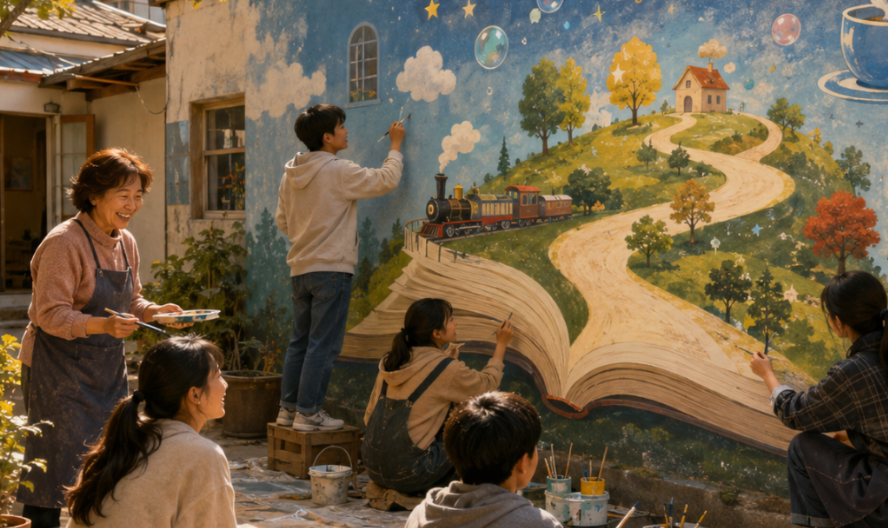
Learn Korean through an original story about a neighborhood bookstore, an empty wall, and the people who decide to leave their memories in color.
This lesson is designed for B1-level Korean learners. It includes a Korean story, natural English translation, essential vocabulary, intermediate grammar explanations, cultural notes, and a reading quiz.
What You Will Learn
- Bookstore, painting, community, and memory-related vocabulary
- Expressions used when proposing and organizing a project
- -는 바람에, -(으)ㄹ 뿐만 아니라, and -더라도
- Korean neighborhood bookstores, community murals, and handwritten recommendation cards
Korean Story
책방 뒤편의 벽화- Written by AI
지우는 서울의 한 고등학교에 다니는 2학년 학생이었다.
지우는 어릴 때부터 책 읽는 것을 좋아했다. 사람이 많은 곳에서는 쉽게 긴장했지만, 책을 읽을 때만큼은 마음이 편안해졌다.
학교 수업이 끝난 뒤 곧바로 집에 가지 않는 날도 많았다.
그럴 때마다 지우는 학교에서 지하철역으로 가는 길에 있는 작은 책방에 들렀다.
책방의 이름은 산책책방이었다.
넓은 대형 서점은 아니었다. 안으로 들어가면 책장 여섯 개와 작은 계산대, 두 사람이 앉을 수 있는 나무 의자가 전부였다.
하지만 지우는 그곳을 좋아했다.
책방 주인인 오미란 씨는 손님이 찾는 책을 잘 기억했다.

지우가 시험 기간에 들어오면 문제집을 권하지 않았다. 대신 짧게 읽을 수 있는 에세이나 얇은 소설을 계산대 옆에 놓아 두었다.
“공부하기 싫을 때 열 쪽만 읽어 봐.”
미란 씨는 자주 그렇게 말했다.
지우는 열 쪽만 읽으려고 책을 펼쳤다가 버스 두 대를 보내 버린 적도 있었다.
산책책방에는 특별한 게시판이 하나 있었다.
게시판에는 손님들이 직접 쓴 책 추천 카드가 붙어 있었다.
카드에는 책의 내용을 길게 옮겨 적지 않았다.
대신 자신이 언제 그 책을 읽었는지, 어떤 기분이 들었는지, 누구에게 추천하고 싶은지를 적었다.
새 학교에 가기 전날 읽은 책입니다.
걱정이 사라지지는 않았지만 조금 덜 외로웠습니다.
할머니와 함께 읽었습니다.
같은 장면에서 서로 다른 이야기를 떠올렸습니다.
일이 잘되지 않는 날, 천천히 읽으면 좋은 책입니다.
지우도 카드 한 장을 쓴 적이 있었다.
중학교를 졸업한 겨울에 읽은 여행 에세이에 관한 카드였다.
멀리 떠나지 않아도 익숙한 길을 새롭게 볼 수 있다는 것을 배웠습니다.
지우는 자신의 이름 대신 근처 고등학생이라고 적었다.
미란 씨는 그 카드를 게시판 가운데에 붙여 주었다.
어느 월요일 오후, 지우는 평소처럼 산책책방의 문을 열었다.
문 위의 작은 종이 맑게 울렸다.
그런데 책방 안의 분위기가 평소와 달랐다.
책장 앞에는 빈 상자들이 놓여 있었고, 계산대 옆에는 포장용 끈과 테이프가 쌓여 있었다.
책장 한 칸은 이미 비어 있었다.
지우는 가방을 내려놓지 못한 채 물었다.
“책을 정리하고 계세요?”
미란 씨는 상자 안에 책을 넣다가 손을 멈췄다.
“응. 이제 조금씩 정리해야 해.”
“새 책이 들어와서 자리를 만드는 거예요?”
미란 씨는 잠시 지우를 바라보았다.
그러고는 조용히 대답했다.
“다음 달에 책방 문을 닫으려고 해.”
지우는 바로 말을 하지 못했다.
책방의 벽시계가 움직이는 소리가 유난히 크게 들렸다.
“문을 닫는다고요?”
“응. 이번 달 마지막 토요일까지만 운영할 거야.”
“왜요? 손님이 너무 적어서 그래요?”
“그 이유도 조금은 있어.”
미란 씨는 의자를 계산대 앞으로 가져왔다.
“그런데 가장 큰 이유는 가족 때문이야. 언니가 다른 지역에서 작은 가게를 운영하고 있는데, 건강이 좋지 않아서 당분간 내가 도와주기로 했어.”
“다시 돌아오실 수도 있어요?”
“아직은 모르겠어. 몇 달이 될 수도 있고, 더 오래 걸릴 수도 있어.”
지우는 비어 있는 책장을 바라보았다.
산책책방이 없는 길을 상상해 보려고 했지만 잘되지 않았다.
학교가 힘든 날이면 이곳에 왔다.
친구와 작은 오해가 생긴 날에도 책방에 왔다.
시험을 망친 뒤 집에 바로 들어가기 싫었던 날에는 나무 의자에 앉아 아무 책이나 펼쳤다.
미란 씨는 지우에게 무슨 일이 있었는지 자세히 묻지 않았다.
그저 따뜻한 차를 한 잔 건네고, 혼자 있고 싶어 보이면 조용히 계산대 일을 했다.
“게시판의 카드들은 어떻게 해요?”
지우가 물었다.
미란 씨는 책 추천 게시판을 바라보았다.
“작성한 분들이 원하면 가져가실 수 있게 할 거야. 남은 카드는 사진으로 보관하려고 해.”
“책방 안의 물건도 모두 없어져요?”
“책장과 의자는 중고로 판매하거나 필요한 곳에 기부할 생각이야.”
미란 씨는 가게 뒤쪽 문을 가리켰다.
“대신 저 벽은 남을 거야.”
책방 계산대 뒤에는 작은 문이 하나 있었다.
문을 열면 건물 뒤편의 좁은 마당으로 나갈 수 있었다.
마당 한쪽에는 회색 벽이 있었다.
벽은 오래되어 얼룩이 많았고, 아래쪽에는 페인트가 조금 벗겨져 있었다.
지우는 그 벽을 여러 번 보았지만 특별히 관심을 가진 적은 없었다.
“건물 주인분이 다음 가게가 들어오기 전에 벽을 새로 칠할 거래.”
미란 씨가 말했다.
“그럼 저 벽도 곧 사라지는 거네요.”
“지금 모습은 없어지겠지.”
지우는 회색 벽 앞에 서 있었다.
문을 닫는 책방과 곧 하얗게 칠해질 벽이 비슷하게 느껴졌다.
오랫동안 그곳에 있었지만, 시간이 지나면 처음부터 아무것도 없었던 것처럼 보일 것 같았다.
“벽에 그림을 그리면 안 될까요?”
지우의 입에서 갑자기 말이 나왔다.
미란 씨가 놀란 표정으로 물었다.
“벽화를 말하는 거야?”
“네. 책방과 관련된 그림을 남기는 거예요.”
“그런데 다음 가게가 들어오면 다시 지울 수도 있어.”
“그래도 괜찮아요.”
지우는 잠시 생각을 정리했다.
“영원히 남지 않더라도 책방이 문을 닫기 전에 사람들이 함께 만든 게 하나 있으면 좋겠어요.”
미란 씨는 회색 벽을 한참 바라보았다.
“건물 주인에게 먼저 허락을 받아야 해.”
“제가 계획서를 만들어 볼게요.”
“계획서까지?”
“벽의 크기와 필요한 재료, 작업 날짜를 정리하면 설명하기 쉬울 것 같아요.”
미란 씨는 웃었다.
“지우가 이런 일을 먼저 하겠다고 말할 줄은 몰랐네.”
지우도 자신이 조금 낯설게 느껴졌다.
평소에는 여러 사람 앞에서 자신의 의견을 쉽게 말하지 못했다.
하지만 이번에는 아무것도 하지 않은 채 책방이 사라지는 모습을 보고 싶지 않았다.
“제가 그림을 아주 잘 그리는 건 아니에요.”
지우가 말했다.
“그래도 디자인은 생각해 볼 수 있어요. 혼자 하기 어렵다면 사람들을 모으면 되고요.”
미란 씨는 고개를 끄덕였다.
“그럼 건물 주인에게 연락해 볼게.”
다음 날, 지우는 학교 점심시간에 공책을 펼쳤다.
먼저 책방 뒤편의 벽 크기를 적었다.
전날 미란 씨가 보내 준 길이와 높이를 이용했다.
가로 5미터
높이 2.4미터
지우는 벽화의 중심 주제를 고민했다.
책을 크게 그리는 것은 쉬웠지만 너무 평범하게 느껴졌다.
실제 책 표지나 유명한 작품 속 인물을 그대로 그리면 저작권이나 상표 문제가 생길 수도 있었다.
지우는 특정 작품을 복사하지 않고도 책방의 분위기를 보여 줄 방법을 찾고 싶었다.
공책 한쪽에 작은 길을 그려 보았다.
길 양쪽에는 책 모양의 집들이 있었다.
어떤 책은 창문처럼 열려 있었고, 어떤 책에서는 나무와 별, 구름이 자라나고 있었다.
길 끝에는 작은 의자 하나가 있었다.
지우는 그림 아래에 적었다.
한 권의 책에서 시작되는 여러 개의 길
그때 같은 반 친구인 나연이 지우의 공책을 보았다.
“무슨 그림이야?”
지우는 공책을 덮을까 하다가 다시 펼쳤다.
“학교 근처 책방이 곧 문을 닫거든.”
“산책책방?”
“너도 알아?”
“응. 초등학생 때 엄마랑 몇 번 갔어.”
지우는 벽화 계획을 설명했다.
나연은 디자인 미술을 좋아했고 학교 행사 포스터를 여러 번 만든 적이 있었다.
“이 길을 벽 전체에 그리면 예쁘겠다.”
나연이 말했다.
“그런데 두 명이 하기에는 벽이 너무 크지 않아?”
“사람들을 더 모으려고 해.”
“나도 해도 돼?”
지우는 예상하지 못한 질문에 잠시 멈췄다.
“정말 같이 할 거야?”
“응. 요즘은 학원만 가서 그림을 크게 그릴 기회가 없었어.”
나연은 공책을 자신 쪽으로 조금 당겼다.
“책에서 나오는 것들을 전부 다르게 그리면 어때? 한쪽에서는 바다가 나오고, 다른 쪽에서는 도시 불빛이 나오는 거야.”
“특정 이야기의 장면처럼 보이지 않게 우리가 직접 만들면 좋을 것 같아.”
“그럼 모두에게 ‘책을 읽을 때 떠오르는 이미지’를 하나씩 물어보자.”
두 사람은 점심시간 동안 기본 계획을 세웠다.
벽화에는 실제 책 제목이나 작가의 문장을 넣지 않기로 했다.
특정 출판사의 로고나 책 표지도 그리지 않기로 했다.
대신 손님들이 직접 떠올린 장소, 색, 계절과 감정을 이용하기로 했다.
수업이 끝난 뒤 지우와 나연은 산책책방으로 갔다.
미란 씨는 건물 주인에게 허락을 받은 상태였다.
“다음 가게가 들어오기 전까지 벽을 자유롭게 사용해도 된대.”
“그림이 계속 남을 수도 있어요?”
“다음에 들어오는 사람이 마음에 들어 하면 남겠지. 하지만 지워질 가능성도 있어.”
지우는 고개를 끄덕였다.
“처음부터 그 점을 알고 시작할게요.”
미란 씨는 벽을 청소할 수 있는 도구와 오래된 사다리를 준비해 주겠다고 했다.
하지만 페인트와 붓은 새로 사야 했다.
“재료비가 꽤 들 것 같은데요.”
나연이 말했다.
“남은 책 중 일부를 할인 판매하고, 수익의 일부를 벽화 재료비로 쓰면 어떨까?”
미란 씨가 제안했다.
지우는 잠시 생각했다.
“사람들이 원하면 작은 금액을 보탤 수 있게 해도 좋을 것 같아요. 하지만 꼭 돈을 내야 참여할 수 있는 건 아니고요.”
“그럼 책방 입구에 안내문을 붙이자.”
세 사람은 큰 종이에 안내문을 작성했다.
산책책방의 마지막 벽화를 함께 만듭니다.
여러분이 책을 읽을 때 떠올리는 색, 장소 또는 마음을 알려 주세요.
실제 책 문장이나 표지를 복사하지 않고 새로운 그림으로 표현합니다.
그림 그리기, 벽 청소, 간식 준비 등 다양한 방법으로 참여할 수 있습니다.
안내문 아래에는 참여 가능한 날짜와 연락 방법을 적었다.
미란 씨는 책 추천 게시판 옆에 안내문을 붙였다.
처음 이틀 동안은 신청하는 사람이 많지 않았다.
지우는 사람들이 관심이 없는 것 같아 걱정했다.
하지만 목요일 저녁부터 작은 메모들이 들어오기 시작했다.
저는 책을 읽으면 창문이 하나 더 생기는 기분이 듭니다.
어릴 때 읽은 이야기를 생각하면 여름밤과 수박 냄새가 떠오릅니다.
힘든 날에는 조용한 숲을 걷는 느낌을 주는 책을 찾습니다.
기차에서 책을 읽으면 실제로 더 멀리 가는 것 같습니다.
책을 읽어 주던 아버지의 낮은 목소리가 생각납니다.
지우와 나연은 메모를 바닥에 펼쳐 놓았다.
“창문, 여름밤, 숲, 기차, 목소리.”
나연이 하나씩 읽었다.
“전부 넣을 수 있을까?”
“모두 크게 그릴 필요는 없어. 작은 장면으로 연결하면 돼.”
지우는 길 모양의 밑그림을 다시 그렸다.
길의 시작에는 열려 있는 책이 있었다.
그 안에서 작은 기차가 나왔다.
기차가 지나가는 곳에는 숲과 여름밤의 창문이 있었다.
길 위에는 의자, 찻잔, 작은 별과 여러 색의 문이 이어졌다.
마지막에는 책방과 비슷하지만 똑같지는 않은 작은 집을 그렸다.
집의 문은 닫혀 있지 않았다.
반쯤 열린 문 안쪽에서 따뜻한 빛이 나왔다.
“책방이 문을 닫는데 왜 문을 열어 놨어?”
나연이 물었다.
“이 가게의 문은 닫혀도 여기서 알게 된 이야기까지 끝나는 건 아니니까.”
나연은 잠시 그림을 바라보다가 미소를 지었다.
“그럼 길도 벽 밖으로 이어지는 것처럼 그리자.”
주말이 되자 첫 번째 작업이 시작되었다.
토요일 아침 9시, 지우와 나연은 작업복을 입고 책방에 도착했다.
미란 씨는 장갑과 마스크, 청소용 솔을 준비해 두었다.
벽화를 그리기 전에 오래된 페인트 조각과 먼지를 제거해야 했다.
책방 단골인 대학생 윤호도 도착했다.
1층 빵집을 운영하는 정미 씨도 앞치마 대신 낡은 운동복을 입고 왔다.
초등학생 딸과 함께 온 주민도 있었다.
모두 그림을 잘 그리는 사람은 아니었다.
하지만 벽을 닦거나 바닥에 신문지를 펴는 일은 누구나 할 수 있었다.
“먼저 벽 아래쪽부터 솔로 문질러 주세요.”
지우가 말했다.
여러 사람 앞에서 설명하려니 목소리가 떨렸다.
지우는 준비한 종이를 다시 확인했다.
“페인트 조각이 떨어지면 바로 봉투에 넣고요. 사다리는 어른과 함께 사용해 주세요.”
정미 씨가 웃으며 말했다.
“오늘 지우가 작업 반장이네.”
지우는 얼굴이 조금 뜨거워졌다.
“제가 계획을 정리해서요.”
“잘하고 있어.”
사람들은 두 시간 동안 벽을 청소했다.
벽을 문지르는 바람에 먼지가 많이 날렸다.
지우는 마스크를 썼지만 코끝이 간지러웠다.
아래쪽의 오래된 얼룩은 생각보다 잘 지워지지 않았다.
윤호가 물에 세제를 조금 섞어 다시 닦았다.
나연은 벽의 갈라진 부분을 표시했다.
벽화용 페인트를 바르기 전에 작은 틈을 메워야 했다.
“그림만 그리면 되는 줄 알았는데 준비가 더 오래 걸리네.”
나연이 말했다.
“무엇이든 시작하기 전이 더 복잡한가 봐.”
지우가 대답했다.
점심시간이 되자 정미 씨가 빵과 우유를 가져왔다.
빵에는 특정 상표나 포장지가 없었다. 빵집에서 직접 만든 작은 빵을 종이봉투에 담아 왔다.
사람들은 책방 뒤편 계단에 앉아 점심을 먹었다.
초등학생 민아가 지우에게 물었다.
“저도 그림을 그릴 수 있어요?”
“물론이지.”
“그런데 저는 기차를 잘 못 그려요.”
“기차가 아니어도 괜찮아. 책을 읽으면 무엇이 생각나?”
민아는 잠시 고민했다.
“저는 비눗방울이 생각나요.”
“왜?”
“이야기 속에서는 제가 가 보지 못한 곳도 볼 수 있잖아요. 비눗방울 안에 작은 세상이 있는 것 같아요.”
지우는 메모지에 민아—작은 세상이 든 비눗방울이라고 적었다.
“벽화에 꼭 넣자.”
민아의 얼굴이 밝아졌다.
첫날에는 벽을 청소하고 바탕색을 칠하는 데까지 진행했다.
회색이었던 벽은 따뜻한 아이보리색으로 변했다.
그것만으로도 마당이 훨씬 밝아 보였다.
사람들은 오후 4시쯤 작업을 마쳤다.
페인트가 마르려면 하루 이상 기다려야 했다.
지우는 집에 돌아와 침대에 누웠다.
온몸이 피곤했고 팔도 아팠다.
하지만 휴대전화에 저장된 벽 사진을 몇 번이나 다시 보았다.
아직 아무 그림도 없었지만 지우에게는 이미 특별한 벽처럼 느껴졌다.
일요일 저녁, 지우는 세부 밑그림을 완성했다.
누가 어떤 부분을 그릴지도 표시했다.
나연은 큰 길과 기차를 담당했다.
윤호는 나무와 건물을 그리기로 했다.
민아는 비눗방울과 별을 그렸다.
정미 씨는 빵 모양이 아니라 따뜻한 창문과 찻잔을 그리고 싶다고 했다.
미란 씨는 책방 문을 닫는 사람이라서 벽화에는 참여하지 않겠다고 처음에는 말했다.
“손님들이 만든 그림을 보는 것만으로도 충분해.”
하지만 지우는 미란 씨에게 작은 부분 하나를 남겨 두었다.
그곳에는 아직 아무 디자인도 정하지 않았다.
두 번째 작업일은 다음 주 토요일이었다.
그런데 금요일 저녁부터 비가 내리기 시작했다.
일기예보에는 토요일 오후까지 비가 계속될 가능성이 있다고 나왔다.
벽은 건물 지붕 아래에 있었지만 바람이 강하면 빗물이 들어올 수 있었다.
지우는 참여자들에게 메시지를 보냈다.
내일 오전 날씨를 확인한 뒤 작업 여부를 다시 알려 드리겠습니다.
토요일 아침에도 비는 그치지 않았다.
지우는 작업을 취소해야 할지 고민했다.
책방이 문을 닫기까지는 일주일밖에 남지 않았다.
다음 주에도 비가 오면 벽화를 완성하지 못할 수도 있었다.
지우는 미란 씨에게 전화했다.
“오늘은 벽에 직접 그리기 어려울 것 같아요.”
“안전이 먼저니까 무리하지 말자.”
“대신 실내에서 할 수 있는 일을 하면 어떨까요?”
“어떤 일?”
“작은 도안을 미리 만들고 색을 섞어 놓는 거예요. 벽에 옮겨 그릴 선도 큰 종이에 준비하고요.”
미란 씨는 좋은 생각이라고 했다.
참여자들은 예정대로 책방에 모였다.
비가 오는 바람에 야외 작업은 하지 못했지만, 사람들은 실내에서 각자의 부분을 연습했다.
민아는 여러 크기의 비눗방울을 종이에 그렸다.
나연은 기차의 모양을 단순하게 바꾸었다.
실제 기차 회사의 디자인처럼 보이지 않도록 로고와 특정 색 조합은 사용하지 않았다.
윤호는 책 모양의 건물들을 그렸다.
건물마다 창문의 모양을 다르게 했다.
정미 씨는 따뜻한 찻잔에서 나오는 김이 구름과 연결되는 그림을 만들었다.
지우는 사람들이 그린 그림을 하나의 길로 연결했다.
처음에는 비 때문에 계획이 실패했다고 생각했다.
하지만 실내에서 충분히 연습하자 실제 벽에 그릴 때 실수할 가능성이 줄어들었다.
나연이 말했다.
“비가 와서 오히려 그림이 더 좋아진 것 같아.”
“시간을 잃은 줄 알았는데 준비 시간을 얻었네.”
지우가 대답했다.
오후가 되자 책방에 손님들이 들어왔다.
그들은 작업 중인 종이를 구경하고 새로운 의견을 남겼다.
한 중년 남성은 작은 우체통을 그려 달라고 부탁했다.
“대학생 때 친구와 책을 바꿔 읽었어요. 서로 책 사이에 편지를 넣어 두었죠.”
한 여성은 벽화에 계단이 있었으면 좋겠다고 했다.
“저는 책 한 권을 다 읽을 때마다 계단 하나를 올라간 기분이 들거든요.”
지우는 모든 요청을 그대로 넣지는 않았다.
벽이 너무 복잡해질 수 있었기 때문이다.
대신 우체통은 길 옆에 작게 넣고, 계단은 책방 문으로 이어지게 했다.
“사람들의 이야기를 듣는 것도 중요하지만, 전체 그림이 하나로 보여야 해.”
나연이 말했다.
“맞아. 모두의 의견을 넣는다는 게 모든 것을 똑같이 크게 그린다는 뜻은 아니니까.”
지우는 처음으로 협업의 어려움을 이해했다.
사람마다 좋아하는 장면과 색이 달랐다.
한 사람이 넓게 그리고 싶은 곳을 다른 사람은 비워 두고 싶어 했다.
누군가는 밝은 색을 좋아했고, 누군가는 차분한 색을 원했다.
지우는 어느 한쪽의 의견만 선택하지 않으려고 노력했다.
대신 그림의 중심 주제에 맞는지 설명하고, 필요하면 크기나 위치를 조정했다.
다음 날 오후, 비가 그쳤다.
지우와 나연은 책방으로 가서 벽 상태를 확인했다.
벽 아래쪽은 조금 젖어 있었지만 위쪽은 괜찮았다.
둘은 선풍기와 마른 천을 이용해 벽을 말렸다.
월요일부터 목요일까지는 학교가 끝난 뒤 한 시간씩 작업하기로 했다.
한 번에 많은 사람이 모이기 어려워서 작은 그룹으로 나누었다.
월요일에는 지우와 나연이 큰 밑그림을 벽에 옮겼다.
연한 색연필과 지워지는 분필을 사용했다.
화요일에는 윤호와 미란 씨가 나무와 책 모양 건물의 바탕색을 칠했다.
수요일에는 민아와 어머니가 비눗방울과 작은 별을 그렸다.
목요일에는 정미 씨가 창문과 찻잔을 완성했다.
작업은 계획대로만 진행되지 않았다.
화요일에는 페인트 한 통의 색이 예상보다 너무 어두웠다.
사람들은 흰색을 조금씩 섞어 원하는 색을 만들었다.
수요일에는 민아가 그린 비눗방울 하나가 너무 커서 기차 일부를 가렸다.
지우는 그림을 지우는 대신 비눗방울 안에 기차가 비치는 것처럼 선을 다시 그렸다.
목요일에는 바람이 부는 바람에 종이컵 하나가 넘어졌다.
다행히 페인트는 바닥에 깔아 둔 천 위에 떨어졌다.
실수는 계속 생겼지만 그림은 조금씩 완성되어 갔다.
책방을 지나가는 사람들도 잠시 마당에 들어와 벽화를 보았다.
“어제보다 길이 더 길어졌네요.”
“저 창문은 우리 집 창문처럼 보여요.”
“벽이 이렇게 넓은 줄 몰랐어요.”
지우는 사람들이 벽화의 변화를 알아보는 것이 기뻤다.
처음에는 혼자 생각한 계획이었지만 이제는 많은 사람의 시간이 들어간 그림이 되었다.
마지막 작업일은 책방이 문을 닫기 하루 전인 금요일이었다.
아직 남아 있는 부분은 길 끝의 작은 책방과 벽화 아래쪽의 짧은 문장이었다.
지우는 문장을 오래 고민했다.
유명한 작가의 문장을 인용하지 않고, 벽화에 어울리는 새로운 문장을 직접 만들고 싶었다.
지우는 여러 문장을 공책에 적었다.
책은 닫혀도 이야기는 계속된다.
한 권의 책은 또 다른 길의 시작이다.
우리가 읽은 시간은 사라지지 않는다.
나연은 세 문장을 읽었다.
“첫 번째 문장이 책방 상황과 가장 잘 맞는 것 같아.”
“너무 슬프지는 않을까?”
“끝난다는 이야기만 있는 건 아니잖아. 계속된다고 했으니까.”
지우는 첫 번째 문장을 선택했다.
하지만 벽에 너무 크게 쓰지는 않았다.
그림 아래쪽에 작고 차분한 글씨로 적었다.
책은 닫혀도 이야기는 계속된다.
문장에는 특정 작품이나 브랜드를 떠올리게 하는 글꼴을 사용하지 않았다.
지우와 나연이 만든 단순한 손글씨였다.
이제 미란 씨가 그릴 부분만 남아 있었다.
길 끝의 작은 책방 문 안쪽이었다.
“여기는 사장님이 그려 주세요.”
지우가 말했다.
“나는 그림을 잘 못 그려.”
“아주 작은 것 하나면 돼요.”
미란 씨는 붓을 들고 한참 고민했다.
그러고는 책방 문 안쪽에 작은 노란 의자를 그렸다.
산책책방에 있던 나무 의자와 모양은 달랐지만 비슷한 따뜻함이 느껴졌다.
의자 위에는 아무도 앉아 있지 않았다.
대신 펼쳐진 책 한 권이 놓여 있었다.
“왜 사람 대신 책을 그렸어요?”
민아가 물었다.
미란 씨는 붓을 내려놓으며 대답했다.
“누가 오든 잠깐 앉아 읽을 수 있는 자리였으면 해서.”
지우는 그 그림을 오래 바라보았다.
벽화는 오후 7시쯤 완성되었다.
사람들은 몇 걸음 뒤로 물러나 전체 그림을 바라보았다.
열린 책에서 시작된 길이 벽 전체를 지나갔다.
길 옆에는 숲과 여름밤, 기차, 비눗방울, 우체통과 계단이 있었다.
찻잔에서 나온 구름은 작은 별과 연결되었다.
길의 끝에는 노란 불빛이 나오는 작은 책방이 있었다.
그림 속 길은 벽의 오른쪽 끝에서 끊어지지 않았다.
벽 밖으로 계속 이어지는 것처럼 가느다란 선이 남아 있었다.
“완성됐어요.”
민아가 말했다.
미란 씨는 바로 대답하지 않았다.
그녀는 벽을 천천히 바라보았다.
그러다가 눈가를 손으로 가볍게 닦았다.
“울어요?”
민아가 물었다.
“페인트 냄새 때문에 눈이 조금 따가워서 그래.”
미란 씨는 웃으며 대답했다.
하지만 지우는 그것이 전부가 아니라는 것을 알았다.
책방의 마지막 운영일인 토요일이 되었다.
평소보다 많은 사람이 산책책방을 찾았다.
책을 사러 온 사람도 있었고, 추천 카드를 가져가러 온 사람도 있었다.
오랫동안 오지 못했던 손님이 인사를 하러 오기도 했다.
미란 씨는 책방 안의 책 대부분을 할인해서 판매했다.
남은 책들은 지역 아동센터와 작은 도서실에 보내기로 했다.
책 추천 게시판의 카드는 모두 사진으로 기록했다.
원하는 사람들은 자신이 쓴 카드를 가져갔다.
지우는 중학교 졸업 후에 작성했던 자신의 카드를 발견했다.
멀리 떠나지 않아도 익숙한 길을 새롭게 볼 수 있다는 것을 배웠습니다.
지우는 카드를 손에 들고 잠시 고민했다.
“가져갈 거야?”
미란 씨가 물었다.
“아니요. 이건 책방에 두고 싶어요.”
“책방은 오늘 문을 닫는데?”
“사장님이 가지고 계시면 좋겠어요.”
미란 씨는 카드를 받아 계산대 서랍에 넣었다.
오후 4시에는 벽화 앞에서 작은 모임이 열렸다.
거창한 행사는 아니었다.
참여한 사람들과 책방 손님들이 뒤편 마당에 모여 사진을 찍고 따뜻한 차를 마셨다.
누구도 긴 연설을 준비하지 않았다.
대신 원하는 사람은 책방과 관련된 짧은 기억을 이야기했다.
정미 씨는 빵집을 처음 열었을 때의 일을 말했다.
“손님이 거의 없던 날, 미란 씨가 책방 손님들에게 우리 빵집을 소개해 줬어요. 그때 받은 첫 주문을 아직도 기억해요.”
윤호는 대학교 입학시험을 준비하던 시절을 떠올렸다.
“공부가 안 될 때마다 여기 와서 여행책을 읽었습니다. 책을 읽는 동안에는 시험이 세상의 전부가 아닌 것처럼 느껴졌어요.”
민아의 어머니는 딸이 처음 혼자 책을 고른 장소가 산책책방이었다고 말했다.
민아도 손을 들었다.
“저는 비눗방울을 그려서 재미있었어요. 다음에도 큰 그림을 그리고 싶어요.”
사람들이 웃고 박수를 쳤다.
마지막으로 미란 씨가 앞으로 나왔다.
“저는 이 책방을 18년 동안 운영했습니다.”
미란 씨는 벽화와 사람들을 번갈아 바라보았다.
“처음에는 제가 사람들에게 책을 소개한다고 생각했어요. 그런데 시간이 지나고 보니 손님들이 저에게 더 많은 것을 알려 주었습니다.”
그녀는 책 추천 게시판에서 떼어 낸 카드 몇 장을 들었다.
“책 한 권이 어떤 사람에게는 여행이 되고, 어떤 사람에게는 위로가 되고, 또 다른 사람에게는 대화를 시작할 이유가 된다는 걸 배웠습니다.”
미란 씨는 지우를 바라보았다.
“이 벽화도 비슷한 것 같아요. 한 사람이 시작했지만 한 사람의 그림으로 끝나지 않았으니까요.”
사람들의 시선이 지우에게 향했다.
지우는 갑자기 얼굴이 뜨거워졌다.
평소 같으면 뒤로 숨고 싶었을 것이다.
하지만 이번에는 작은 목소리로 말했다.
“혼자였다면 시작하지 못했을 거예요.”
“그래도 처음 말한 사람은 지우잖아.”
나연이 말했다.
사람들이 다시 박수를 쳤다.
오후 7시가 되자 마지막 손님이 책방을 나갔다.
미란 씨는 계산대 서랍을 정리하고 불을 하나씩 껐다.
지우와 나연은 남아서 상자를 옮겼다.
책장 대부분은 비어 있었다.
나무 의자는 다음 날 지역 공부방으로 가져갈 예정이었다.
미란 씨는 책방 문 앞에 섰다.
“이제 정말 닫아야겠네.”
지우는 밖으로 나간 뒤 책방 간판을 올려다보았다.
미란 씨는 문을 잠그고 손잡이를 한 번 확인했다.
문 위의 종은 더 이상 울리지 않았다.
세 사람은 건물 뒤편으로 돌아갔다.
벽화는 작은 조명 아래에서 낮과 다르게 보였다.
노란 창문과 별이 더 밝게 느껴졌다.
미란 씨는 휴대전화로 벽화를 찍었다.
“언니에게도 보여 줘야겠다.”
“마음에 들어 하실 거예요.”
지우가 말했다.
“다음 가게가 들어와서 벽화를 지우더라도 섭섭해하지 않을 거야?”
미란 씨가 물었다.
지우는 처음 벽화 계획을 세우던 날을 떠올렸다.
그때는 그림이 오래 남기를 바랐다.
하지만 지금은 조금 다르게 생각했다.
벽화가 언젠가 사라지더라도 사람들은 함께 청소하고, 색을 섞고, 비를 기다리며 그림을 완성한 시간을 기억할 것이다.
“조금 아쉽기는 할 것 같아요.”
지우가 솔직하게 말했다.
“하지만 지워지더라도 우리가 만들었다는 사실은 없어지지 않아요.”
나연도 고개를 끄덕였다.
“사진도 많이 찍었고요.”
미란 씨는 지우와 나연의 손을 한 번씩 잡았다.
“고마워.”
한 달이 지났다.
지우는 산책책방이 있던 길을 계속 지나갔다.
처음 며칠 동안은 문이 닫힌 가게를 볼 때마다 마음이 이상했다.
창문 안쪽은 비어 있었고 간판도 내려간 상태였다.
하지만 건물 뒤편의 벽화는 그대로 남아 있었다.
근처 주민들은 가끔 벽화 앞에서 사진을 찍었다.
아이들은 비눗방울과 기차를 찾으며 그림을 구경했다.
정미 씨는 빵집에서 작은 의자 두 개를 가져와 벽화 근처에 놓았다.
“사람들이 잠깐 앉아서 볼 수 있게 하려고.”
어느 화요일 오후, 지우가 벽화 앞에 갔을 때 낯선 여성이 서 있었다.
여성은 빈 책방의 새로운 임차인이었다.
그녀는 그곳에 작은 공방을 열 계획이라고 했다.
“이 벽화를 만든 학생인가요?”
여성이 물었다.
“저 혼자 만든 건 아니에요. 동네 사람들이 같이 만들었어요.”
“그래서 장면이 이렇게 다양하군요.”
여성은 벽화의 오른쪽 끝을 가리켰다.
“그림 속 길이 벽 밖으로 이어지는 것처럼 보여요.”
“일부러 그렇게 그렸어요.”
“저는 이 벽화를 지우지 않으려고 해요.”
지우는 놀라서 여성을 바라보았다.
“정말요?”
“가게 분위기와도 잘 맞고, 동네 사람들이 좋아하는 것 같아요.”
여성은 벽 아래쪽의 문장을 읽었다.
책은 닫혀도 이야기는 계속된다.
“책방은 없어졌지만 다음 공간의 이야기가 여기서 시작되는 것 같네요.”
지우는 가슴속이 따뜻해지는 것을 느꼈다.
하지만 곧 조심스럽게 말했다.
“나중에 필요하면 바꾸셔도 괜찮아요. 처음부터 영원히 남을 거라고 생각하고 만든 건 아니니까요.”
여성은 고개를 끄덕였다.
“그래도 당분간은 그대로 두고 싶어요.”
새 공방은 두 달 뒤 문을 열었다.
그곳에서는 종이 공예와 작은 생활용품 만들기 수업이 열렸다.
산책책방의 책장은 없었지만, 창가에는 사람들이 잠시 앉을 수 있는 의자가 놓였다.
미란 씨가 그린 노란 의자와 비슷한 색이었다.
미란 씨는 언니를 도우며 다른 지역에서 지내고 있었다.
가끔 지우에게 메시지를 보냈다.
오늘도 벽화 사진을 봤어.
언니도 기차와 비눗방울을 좋아하더라.
지우도 새로운 공방과 그대로 남아 있는 벽화 사진을 보내 주었다.
어느 날 미란 씨에게 답장이 왔다.
책방 문은 닫혔지만 정말 이야기는 계속되고 있네.
고등학교 2학기가 시작되자 지우는 학교의 작은 전시 준비팀에 지원했다.
예전 같으면 여러 사람과 의견을 맞춰야 하는 일이 부담스러워서 피했을 것이다.
하지만 벽화 작업을 하며 알게 되었다.
자신이 모든 답을 알고 있지 않더라도 계획을 시작할 수 있었다.
실수가 생기더라도 다른 방법을 찾을 수 있었다.
목소리가 크지 않더라도 필요한 말을 할 수 있었다.
지원서에는 활동 경험을 적는 칸이 있었다.
지우는 산책책방 벽화 프로젝트에 대해 썼다.
문을 닫는 동네 책방의 기억을 남기기 위해 주민들과 벽화를 기획했습니다.
특정 작품의 표지나 문장을 복제하지 않고, 참여자들의 개인적인 독서 경험을 새로운 이미지로 표현했습니다.
날씨와 일정이 바뀌는 상황에서 작업 방식을 조정했고, 여러 사람의 의견을 하나의 그림으로 연결했습니다.
지원서를 제출한 뒤 지우는 학교에서 집으로 걸어갔다.
길 중간에서 새 공방의 불빛이 보였다.
공방 뒤편에는 여전히 벽화가 있었다.
열린 책에서 나온 길은 숲과 기차, 계단과 비눗방울을 지나 작은 문으로 이어졌다.
그리고 벽의 끝을 넘어 보이지 않는 곳까지 계속되고 있었다.
지우는 벽화 앞에서 잠시 멈췄다.
책방은 사라졌지만 그곳에서 시작된 길은 끝나지 않았다.
지우 자신도 전과 같은 자리에 머물러 있지 않았다.
무언가 끝나는 순간에도 다음 이야기를 시작할 수 있다는 것을 이제는 알고 있었다.
Natural English Translation
The Mural Behind the Bookstore
Jiwoo was a second-year student at a high school in Seoul.
She had enjoyed reading since childhood. She became nervous easily in crowded places, but she felt comfortable whenever she was reading.
There were many days when she did not go directly home after school.
On those days, she visited a small bookstore on the way from school to the subway station.
It was called Walking Bookstore.
It was not a large bookstore. Inside were only six bookshelves, a small counter, and a wooden bench for two people.
However, Jiwoo loved the place.
The owner, Oh Miran, remembered what her customers liked to read.
When Jiwoo entered during an examination period, Miran did not recommend study books. Instead, she placed a short essay collection or a thin novel beside the counter.
“Read only ten pages when you don’t feel like studying.”
Miran often said that.
Jiwoo once opened a book intending to read ten pages and allowed two buses to leave without her.
The bookstore had a special recommendation board.
Customers wrote small cards about books they wanted to recommend.
They did not copy long passages from the books.
Instead, they explained when they had read the book, how it made them feel, and who might enjoy it.
Jiwoo had also written one card.
It was about a travel essay she had read during the winter after middle-school graduation.
I learned that I can see a familiar road differently even without traveling far away.
Instead of writing her name, Jiwoo signed the card a nearby high school student.
Miran placed it in the center of the board.
One Monday afternoon, Jiwoo opened the bookstore door as usual.
The small bell above the door rang.
However, the atmosphere inside was different.
Empty boxes stood in front of the shelves, and packing tape and string were piled beside the counter.
One section of a shelf was already empty.
Jiwoo asked whether Miran was reorganizing the books.
Miran stopped packing.
“I need to begin organizing things.”
“Are you making room for new books?”
Miran looked at Jiwoo for a moment.
“I’m going to close the bookstore next month.”
Jiwoo could not answer immediately.
The sound of the wall clock seemed unusually loud.
Miran explained that the bookstore would operate only until the final Saturday of the month.
A decrease in customers was part of the reason, but the main reason involved her family.
Miran’s older sister operated a small shop in another region. Because her health had become poor, Miran had decided to help her.
She did not know when she would return.
Jiwoo looked at the empty shelf.
She could not imagine the road without the bookstore.
On difficult days at school, she came there.
When she had a misunderstanding with a friend, she came there.
After doing badly on an exam, she sat on the wooden bench and opened any book she could find.
Miran never asked too many questions.
She simply offered warm tea and quietly worked at the counter when Jiwoo seemed to want to be alone.
Jiwoo asked what would happen to the recommendation cards.
Miran planned to let people take their own cards and photograph the remaining ones.
The shelves and bench would be sold or donated.
Then Miran pointed to the back door.
A narrow courtyard stood behind the store.
On one side was a large gray wall.
It was old, stained, and covered with peeling paint near the bottom.
“The building owner plans to repaint it before the next business moves in.”
“So this wall will disappear too.”
“Its current appearance will.”
Jiwoo stood in front of the gray wall.
The closing bookstore and the wall that would soon be painted white felt similar.
They had existed for a long time, but they might soon appear as though nothing had ever been there.
“Could we paint a picture on it?”
The words left Jiwoo’s mouth suddenly.
“A mural?”
“Yes. Something connected to the bookstore.”
Miran warned that the next tenant might paint over it.
Jiwoo said that was all right.
“Even if it doesn’t remain forever, I would like people to make something together before the bookstore closes.”
Miran said they would first need permission from the building owner.
Jiwoo offered to create a plan showing the size of the wall, the materials, and the working schedule.
Miran was surprised that Jiwoo had volunteered to lead such a project.
Jiwoo was surprised too.
She normally found it difficult to express her opinion in front of many people.
However, she did not want to watch the bookstore disappear without doing anything.
The following day, Jiwoo opened her notebook during lunch.
She recorded the wall’s size:
Width: 5 meters
Height: 2.4 meters
She considered the mural’s central theme.
Painting a large book would be simple but ordinary.
She also wanted to avoid copying real book covers, copyrighted characters, logos, or passages.
Jiwoo drew a small road.
Book-shaped houses stood on both sides.
Some books opened like windows, while trees, stars, and clouds grew from others.
A chair waited at the end of the road.
Below the drawing, Jiwoo wrote:
Many roads that begin inside one book
Her classmate Nayeon noticed the sketch.
Jiwoo explained that the neighborhood bookstore was closing.
Nayeon knew the store because she had visited it with her mother as a child.
Nayeon enjoyed design and had made several posters for school events.
She suggested filling the wall with different images that people associated with reading.
The two students decided to ask customers about the colors, places, seasons, and emotions that came to mind when they read.
They would not reproduce actual book covers, text, characters, or company logos.
After school, Jiwoo and Nayeon visited the store.
Miran had received permission from the building owner.
The wall could be used freely until a new tenant arrived, although the mural might eventually be removed.
The wall needed cleaning, and paint and brushes had to be purchased.
Miran suggested using part of the money from the closing sale for supplies.
Jiwoo also suggested allowing people to make small voluntary contributions without requiring payment to participate.
Together, they wrote a notice.
We are creating the final mural of Walking Bookstore.
Tell us about a color, place, or emotion that appears in your mind when you read.
We will create new images instead of copying existing book covers or sentences.
You can participate by painting, cleaning the wall, preparing snacks, or helping in another way.
At first, few people responded.
Jiwoo worried that no one was interested.
Beginning Thursday evening, however, small notes appeared.
One person said reading felt like gaining another window.
Another remembered summer nights and the smell of watermelon.
Someone searched for books that felt like walking through a quiet forest.
Another person said reading on a train made the journey feel longer.
One customer remembered the low voice of a father who had read aloud.
Jiwoo and Nayeon spread the notes across the floor.
They connected the ideas into one path.
An open book appeared at the beginning.
A small train came out of it and traveled through a forest and past a summer-night window.
Chairs, cups, stars, and doors stood beside the path.
At the end was a small house that was similar to the bookstore but not identical.
Its door was half open, and warm light came from inside.
Nayeon asked why the door was open when the bookstore was closing.
Jiwoo answered that although the store’s door would close, the stories people had discovered there would not end.
They decided to make the road continue beyond the edge of the wall.
The first workday began on Saturday morning.
Jiwoo, Nayeon, a university student named Yunho, the owner of the bakery downstairs, a young child named Mina, and several other residents gathered.
Not everyone could draw well, but everyone could clean, spread newspaper, or organize tools.
Jiwoo nervously explained the safety rules.
They removed peeling paint and dust from the wall.
Because of the cleaning, dust filled the air.
Old stains were more difficult to remove than expected.
The preparation took longer than the painting itself.
At lunchtime, the bakery owner brought handmade bread and milk.
Mina asked whether she could paint even though she could not draw a train.
Jiwoo asked what reading made her imagine.
“Soap bubbles,” Mina answered. “Stories let me see places I have never visited. It feels like a small world is inside each bubble.”
Jiwoo promised to include the idea.
By the end of the first day, they had cleaned the wall and painted a warm ivory background.
The gray wall already looked brighter.
On Sunday evening, Jiwoo completed the detailed plan and assigned different sections.
Nayeon would paint the road and train.
Yunho would paint trees and buildings.
Mina would paint bubbles and stars.
The bakery owner wanted to paint a warm window and a cup of tea.
Miran initially said she would not paint.
She thought it was enough to see the customers’ artwork.
However, Jiwoo left one small area without a design for her.
Their second major workday was planned for the following Saturday.
Unfortunately, rain began on Friday evening.
It continued on Saturday morning.
Jiwoo worried because only one week remained before the bookstore closed.
She called Miran.
They agreed not to paint outside in unsafe weather.
Instead, the participants gathered inside the bookstore.
They practiced their designs, mixed colors, and prepared larger patterns that could later be transferred to the wall.
Nayeon simplified the train so that it did not resemble the design or color scheme of a real train company.
Yunho designed book-shaped buildings with different windows.
The bakery owner connected steam from a cup of tea to the clouds.
The rain seemed to have ruined their schedule, but the indoor preparation improved the design and reduced the chance of later mistakes.
Customers who entered the bookstore also contributed ideas.
A middle-aged man asked for a mailbox because he had once exchanged books with a friend and placed letters between the pages.
A woman requested stairs because finishing a book felt like climbing one step higher.
Jiwoo did not include every request at full size.
Instead, she added a small mailbox and created stairs leading toward the painted bookstore.
She learned that listening to everyone did not mean making every idea equally large.
A collaborative work still needed a clear center.
The rain stopped the next afternoon.
Jiwoo and Nayeon dried the wall with cloths and a fan.
From Monday through Thursday, small groups worked for an hour after school.
On Monday, Jiwoo and Nayeon transferred the main sketch.
On Tuesday, Yunho and Miran painted the trees and book-shaped buildings.
On Wednesday, Mina and her mother painted bubbles and stars.
On Thursday, the bakery owner completed the windows and cup.
The work did not proceed perfectly.
One paint color was darker than expected.
They added white until it became suitable.
One of Mina’s bubbles covered part of the train.
Instead of removing it, Jiwoo redrew the lines so that the train appeared reflected inside the bubble.
A paper cup fell because of the wind, but the paint landed on a protective cloth.
Mistakes continued, but the mural gradually developed.
People passing the store began visiting the courtyard.
They noticed the new path, windows, and colors.
The mural was no longer only Jiwoo’s idea.
It contained many people’s time and attention.
The final workday was Friday, one day before the bookstore closed.
Only the painted bookstore at the end of the road and a short sentence remained unfinished.
Jiwoo wanted to write an original sentence instead of quoting a famous author.
She considered three choices.
Even when a book closes, the story continues.
One book is the beginning of another road.
The time we spent reading does not disappear.
Nayeon preferred the first sentence.
They wrote it in simple handwriting at the bottom of the mural.
Miran’s section remained empty.
Jiwoo asked her to paint something inside the door of the small bookstore.
Miran said she could not draw well.
Jiwoo told her that one small object would be enough.
After thinking for a long time, Miran painted a small yellow chair.
An open book rested on it.
Mina asked why she had painted a book instead of a person.
Miran answered that she wanted it to be a place where anyone could sit and read.
The mural was completed at around seven in the evening.
Everyone stepped backward.
A path began inside an open book and crossed the entire wall.
It passed a forest, a train, stairs, bubbles, stars, a mailbox, and a cup whose steam became clouds.
At the end stood a small bookstore filled with yellow light.
The road did not stop at the edge of the wall.
A thin line made it seem to continue beyond what people could see.
The following day was the bookstore’s final day.
More people visited than usual.
Some bought books.
Others collected their recommendation cards or came simply to say goodbye.
Remaining books were donated to a children’s center and a small reading room.
At four in the afternoon, a simple gathering was held beside the mural.
People took photographs, drank warm tea, and shared short memories.
The bakery owner remembered the first order she had received after Miran introduced her store to bookstore customers.
Yunho remembered reading travel books while preparing for a major examination.
Mina said she enjoyed painting the bubbles and wanted to create another large picture someday.
Finally, Miran spoke.
She had operated the store for eighteen years.
At first, she believed that she was the person introducing books to others.
Over time, however, her customers taught her more.
She learned that the same book could become a journey, comfort, or a reason to begin a conversation.
The mural was similar.
One person had begun it, but it had not ended as one person’s picture.
Everyone looked at Jiwoo.
Jiwoo felt embarrassed but said that she could not have started alone.
Nayeon reminded her that she had still been the first person to speak.
At seven in the evening, Miran turned off the lights and locked the door.
The bell above it no longer rang.
Jiwoo, Nayeon, and Miran walked to the courtyard.
The mural looked different under the evening light.
The yellow windows and stars seemed brighter.
Miran photographed it to show her sister.
She asked whether Jiwoo would be upset if the next tenant removed it.
Jiwoo admitted she would feel slightly disappointed.
However, even if the paint disappeared, the time they had spent cleaning, mixing colors, waiting for rain, and working together would remain.
One month later, the mural was still there.
Local residents photographed it.
Children looked for the bubbles and train.
The bakery owner placed two small chairs nearby so that people could rest.
One afternoon, Jiwoo met the new tenant.
The woman planned to open a small craft studio.
She asked whether Jiwoo had made the mural.
Jiwoo explained that the neighborhood had made it together.
The woman said she did not plan to remove it.
The mural matched the studio, and local people clearly loved it.
She read the sentence at the bottom.
Even when a book closes, the story continues.
“The bookstore is gone,” she said, “but the next space’s story seems to begin here.”
Jiwoo said the mural could be changed someday if necessary.
They had never expected it to remain forever.
The craft studio opened two months later.
It offered paper-craft and small household-item classes.
There were no bookshelves, but chairs stood beside the window.
They were a similar yellow to the chair Miran had painted.
Miran occasionally sent Jiwoo messages from the region where she was helping her sister.
Jiwoo sent photographs of the new studio and the mural.
Miran replied:
The bookstore closed, but the story really is continuing.
When the next school semester began, Jiwoo applied to join a school exhibition team.
Previously, she would have avoided a project that required coordinating many opinions.
The mural had taught her that she did not need to know every answer before beginning.
When a mistake happened, she could find another method.
Even with a quiet voice, she could say something important.
In her application, Jiwoo described the mural project.
She explained that the group had transformed personal reading memories into original images without copying existing book covers, characters, logos, or passages.
She described adjusting their plans because of weather and combining many ideas into one design.
After submitting the application, Jiwoo walked home.
The new craft studio’s lights were visible ahead.
The mural remained behind it.
The painted road began in an open book, crossed the forest, train, stairs, and bubbles, and continued beyond the edge of the wall.
Jiwoo stopped for a moment.
The bookstore had disappeared, but the road that began there had not ended.
Jiwoo was no longer standing in the same place either.
She now understood that even when something ended, another story could begin.
Essential Vocabulary
KoreanRomanizationMeaning
| 동네 책방 | dongne chaekbang | neighborhood bookstore |
| 문을 닫다 | muneul datda | to close a business |
| 책장 | chaekjang | bookshelf |
| 계산대 | gyesandae | checkout counter |
| 추천 카드 | chucheon kadeu | recommendation card |
| 운영하다 | unyeonghada | to operate; run |
| 정리하다 | jeongnihada | to organize; clear away |
| 기부하다 | gibuhada | to donate |
| 벽화 | byeokhwa | mural |
| 얼룩 | eolluk | stain |
| 벗겨지다 | beotgyeojida | to peel off |
| 계획서 | gyehoekseo | written plan |
| 밑그림 | mitgeurim | preliminary sketch |
| 저작권 | jeojakkwon | copyright |
| 복제하다 | bokjehada | to copy; reproduce |
| 상표 | sangpyo | trademark |
| 재료비 | jaeryobi | material cost |
| 자발적 | jabaljeok | voluntary |
| 참여하다 | chamyeohada | to participate |
| 바탕색 | batangsaek | background color |
| 갈라지다 | gallajida | to crack |
| 메우다 | meuda | to fill a gap |
| 담당하다 | damdanghada | to be responsible for |
| 연결하다 | yeongyeolhada | to connect |
| 조정하다 | jojeonghada | to adjust |
| 협업 | hyeobeop | collaboration |
| 임차인 | imchain | tenant |
| 공방 | gongbang | craft workshop |
| 사라지다 | sarajida | to disappear |
| 이어지다 | ieojida | to continue; be connected |
Key Grammar
1. -는 바람에
This expression describes an unexpected cause that leads to an inconvenient or unplanned result.
It is commonly translated as “because,” “as a result of,” or “due to.”
Story Examples
비가 오는 바람에 야외 작업을 하지 못했어요.
Because it rained unexpectedly, they could not work outside.
바람이 부는 바람에 종이컵이 넘어졌어요.
Because the wind blew, the paper cup fell over.
More Examples
버스가 늦게 오는 바람에 수업에 늦었어요.
Because the bus arrived late, I was late for class.
휴대전화를 집에 두고 오는 바람에 연락하지 못했어요.
Because I left my phone at home, I could not contact anyone.
길을 잘못 찾는 바람에 약속 시간에 늦었어요.
Because I took the wrong road, I was late for the appointment.
갑자기 비가 내리는 바람에 행사가 취소되었어요.
Because it suddenly rained, the event was canceled.
2. -(으)ㄹ 뿐만 아니라
This expression means “not only … but also ….”
It is used to connect two related facts, with the second fact adding more information.
Story Example
벽화에는 그림을 잘 그리는 사람뿐만 아니라 벽을 청소하고 간식을 준비한 사람도 참여했어요.
Not only people who could draw well but also people who cleaned the wall and prepared snacks participated in the mural.
More Examples
이 책은 재미있을 뿐만 아니라 배우는 내용도 많아요.
This book is not only interesting but also educational.
그 친구는 그림을 잘 그릴 뿐만 아니라 사진도 잘 찍어요.
That friend is not only good at drawing but also good at photography.
그곳은 조용할 뿐만 아니라 교통도 편리해요.
That place is not only quiet but also easy to reach.
이번 활동은 즐거웠을 뿐만 아니라 새로운 사람을 만날 기회도 되었어요.
This activity was not only enjoyable but also an opportunity to meet new people.
3. -더라도
This grammar means “even if” or “even though a certain situation may happen.”
It expresses that the main result or decision will remain unchanged.
Story Examples
벽화가 언젠가 지워지더라도 함께 만든 기억은 남을 거예요.
Even if the mural is removed someday, the memory of creating it together will remain.
완벽하게 그리지 못하더라도 끝까지 참여하고 싶어요.
Even if I cannot paint perfectly, I want to participate until the end.
More Examples
조금 어렵더라도 직접 해 보고 싶어요.
Even if it is a little difficult, I want to try it myself.
비가 오더라도 행사는 실내에서 진행됩니다.
Even if it rains, the event will continue indoors.
결과가 좋지 않더라도 배운 점은 있을 거예요.
Even if the result is not good, there will be something to learn.
시간이 오래 걸리더라도 천천히 완성합시다.
Even if it takes a long time, let’s complete it slowly.
Useful Korean Expressions
KoreanNatural English Meaning
| 다음 달에 문을 닫을 예정이에요. | We plan to close next month. |
| 다시 돌아오실 수도 있어요? | Is it possible that you may return? |
| 벽에 그림을 그리면 어떨까요? | What if we paint a picture on the wall? |
| 먼저 허락을 받아야 해요. | We need to get permission first. |
| 계획서를 만들어 볼게요. | I’ll try making a written plan. |
| 어떤 장면이 떠올라요? | What kind of scene comes to mind? |
| 실제 작품을 그대로 복사하지 않을 거예요. | We will not directly copy an existing work. |
| 제가 이 부분을 맡을게요. | I’ll take responsibility for this section. |
| 전체 그림과 잘 어울리는 것 같아요. | It seems to fit well with the whole picture. |
| 일정이 바뀔 수도 있어요. | The schedule may change. |
| 다른 방법을 찾아봅시다. | Let’s find another way. |
| 지워지더라도 기억은 남을 거예요. | Even if it is erased, the memory will remain. |
Korean Culture Notes
Neighborhood Bookstores in Korea
A small independent neighborhood bookstore can be called a 동네 책방 or 독립서점.
Unlike a large bookstore, a neighborhood bookstore may have:
- Books personally selected by the owner
- Handwritten recommendation cards
- Small reading meetings
- Exhibitions or workshops
- A space where regular customers can talk
Some stores focus on a particular subject, age group, or style of book.
The atmosphere and relationship with customers can be as important as the number of books.
Handwritten Book Recommendation Cards
Some bookstores and libraries display short recommendation cards written by staff members or readers.
A useful card usually includes:
- Why the person recommends the book
- When or where they read it
- What feeling remained afterward
- Who may enjoy it
To respect copyright, it is safer to describe a personal response in your own words rather than copying a long passage from the book.
For example:
마음이 복잡한 날 천천히 읽기 좋은 책입니다.
This is a good book to read slowly on a confusing day.
Community Murals
A community mural is a large painting created with the participation of local residents, students, artists, or shop owners.
Before creating one, participants generally need to consider:
- Permission from the building or wall owner
- Safety during the work
- Weather conditions
- Paint and cleaning materials
- Copyrights and trademarks
- Whether emergency routes remain clear
Not every participant needs to be skilled at drawing. Cleaning, planning, photographing, preparing tools, and organizing the area are also important contributions.
Reading Comprehension Quiz
1. Why was Miran planning to close the bookstore?
A. She wanted to open a restaurant.
B. The building was being demolished.
C. She needed to help her older sister.
D. Jiwoo asked her to close it.
2. Why did Jiwoo suggest creating a mural?
A. She wanted to advertise a famous novel.
B. She wanted to leave a shared memory before the bookstore closed.
C. She needed to complete a school assignment.
D. She wanted to sell the wall.
3. What did the participants avoid putting in the mural?
A. Trees and windows
B. Trains and bubbles
C. Original colors and shapes
D. Copied book covers, characters, quotations, and logos
4. How did the group respond when rain stopped the outdoor work?
A. They completely canceled the project.
B. They painted inside the bookstore walls.
C. They practiced designs and prepared materials indoors.
D. They asked another group to finish it.
5. What did Jiwoo learn through the mural project?
Write your answer in two or three sentences.
Quiz Answers
- C — She needed to help her older sister.
- B — She wanted to leave a shared memory before the bookstore closed.
- D — Copied book covers, characters, quotations, and logos
- C — They practiced designs and prepared materials indoors.
- Jiwoo learned that she could begin a project without knowing every answer. She also learned how to adjust plans, combine different opinions, and communicate even though she was usually quiet.
Final Review
After studying this story, you should be able to:
- Talk about bookstores, community projects, and murals.
- Suggest an idea and explain a plan.
- Describe an unexpected cause using -는 바람에.
- Add related information with -(으)ㄹ 뿐만 아니라.
- Express an unchanged decision with -더라도.
- Understand basic copyright awareness in community artwork.
- Describe how people can cooperate even when they have different skills.
Read the Korean story once more without looking at the English translation. Then complete this sentence:
저는 결과가 완벽하지 않더라도 __________을/를 끝까지 해 보고 싶어요.
Even if the result is not perfect, I want to continue trying __________ until the end.
어떤 공간의 문이 닫히더라도, 그곳에서 시작된 이야기는 다른 길에서 계속될 수 있다.
Even when the door of a place closes, the story that began there can continue along another path.
This is a newly written original educational story created exclusively for K-Fiction.com. It is not based on any existing novel, character, film, or copyrighted story. All characters, locations, organizations, dialogue, and events are fictional. The story contains no violence, drugs, sexual content, self-harm, hate speech, or other material unsuitable for teenage readers.