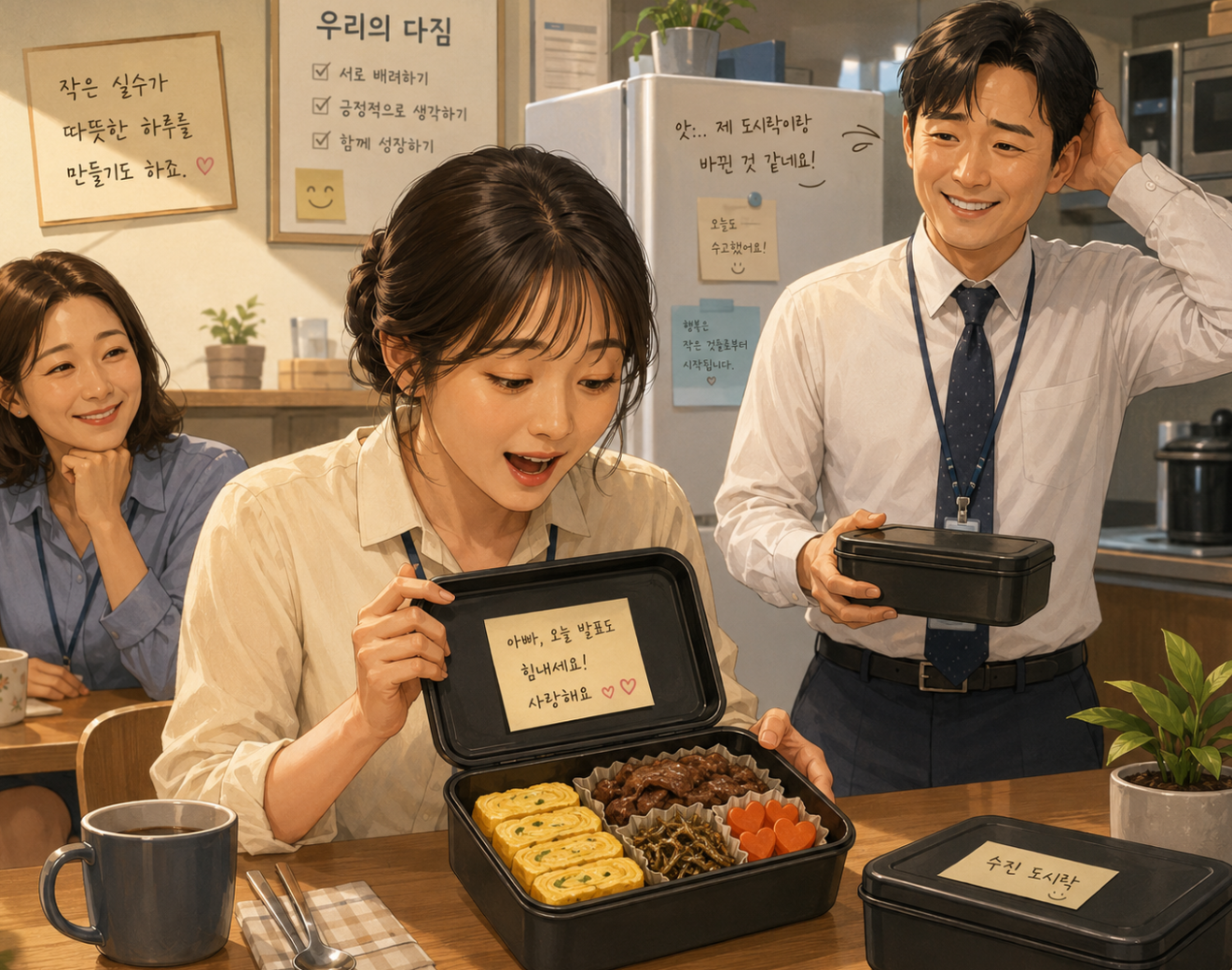
Learn Korean through an original short story about a new employee, a mysterious lunchbox, and an unexpected connection at a Korean office.
This lesson is designed for A2-level Korean learners. It includes a Korean story, natural English translation, essential vocabulary, grammar explanations, cultural notes, and a reading quiz.
What You Will Learn
- Korean office and lunchtime vocabulary
- Polite expressions used with coworkers
- -아/어도 되다, -(으)ㄴ/는 것 같다, and -아/어 버리다
- Common Korean workplace titles and meal expressions
Korean Story
이름 없는 도시락- Written by AI
수진은 서울의 작은 디자인 회사에 새로 입사했다.
입사한 지 사흘밖에 되지 않았기 때문에 아직 모든 것이 낯설었다. 직원들의 이름도 잘 외우지 못했고, 복사기가 어디에 있는지도 자주 잊어버렸다.
점심시간이 되자 옆자리의 지혜 대리가 물었다.
“수진 씨, 오늘도 도시락 가져왔어요?”
“네. 아침에 직접 만들었어요.”
“그럼 휴게실에서 같이 먹어요.”

수진은 냉장고에서 도시락을 꺼냈다. 냉장고 안에는 비슷한 모양의 검은색 도시락이 두 개 있었다.
수진은 왼쪽에 있는 도시락을 들고 휴게실로 갔다.
“잘 먹겠습니다.”
수진이 뚜껑을 열자 예상하지 못한 음식이 보였다.
수진이 준비한 음식은 김밥과 방울토마토였다. 하지만 도시락 안에는 멸치볶음, 달걀말이, 불고기와 하트 모양의 당근이 들어 있었다.
뚜껑 안쪽에는 작은 메모도 붙어 있었다.
아빠, 오늘 발표도 힘내세요!
다 먹고 힘내기!
— 유나
수진은 깜짝 놀랐다.
“이거 제 도시락이 아닌 것 같아요.”
지혜 대리가 도시락을 보며 웃었다.
“그러네요. 수진 씨 도시락은 어디 있어요?”
두 사람은 냉장고로 돌아갔다. 하지만 다른 검은색 도시락도 사라지고 없었다.
“누군가 수진 씨 도시락을 가져간 것 같네요.”
수진은 걱정스러운 표정을 지었다.
“이 도시락 주인은 누구일까요?”
“메모에 ‘아빠’라고 쓰여 있으니까 남자 직원일 것 같아요.”
그때 회의실 문이 열리고 박 팀장이 나왔다. 그는 검은색 도시락을 들고 있었다.
“혹시 이 도시락 주인이 수진 씨예요?”
“네, 맞아요!”
박 팀장은 미안한 얼굴로 도시락을 건넸다.
“냉장고에 똑같은 도시락이 있어서 잘못 가져왔어요. 다행히 아직 열지는 않았습니다.”
수진도 자신이 들고 있던 도시락을 보여 주었다.
“저도 팀장님 도시락을 가져와 버렸어요.”
박 팀장은 자신의 도시락 안에 붙어 있는 메모를 보고 잠시 웃었다.
“딸이 또 메모를 써 줬네요.”
“오늘 중요한 발표가 있으세요?”
“네. 오후에 새 고객 앞에서 발표해야 합니다.”
수진은 도시락을 돌려주며 말했다.
“따님이 응원하셨으니까 발표가 잘될 것 같아요.”
“고마워요. 수진 씨도 제 도시락을 열어서 놀랐겠네요.”
“하트 모양 당근이 아주 예뻤어요.”
박 팀장은 조금 부끄러운 듯 웃었다.
“딸이 아침마다 하나씩 넣어 줍니다.”
세 사람은 휴게실에 함께 앉았다.
지혜 대리가 말했다.
“팀장님, 혼자 드시지 말고 여기서 같이 드세요.”
“그래도 돼요?”
“물론이죠.”
박 팀장은 딸이 만든 달걀말이를 두 사람에게 나누어 주었다. 수진도 자신이 만든 김밥을 건넸다.
“팀장님, 김밥 하나 드셔 보세요.”
“고마워요. 잘 먹겠습니다.”
점심을 먹는 동안 수진은 박 팀장이 생각보다 편안한 사람이라는 것을 알게 되었다.
박 팀장은 회사 근처의 맛있는 식당과 지하철에서 회사까지 오는 가장 빠른 길도 알려 주었다.
오후가 되자 박 팀장은 발표를 위해 회의실로 들어갔다.
한 시간 뒤, 회의실 문이 열렸다. 박 팀장의 얼굴에는 환한 미소가 있었다.
“발표가 잘 끝났어요. 고객도 아주 만족한 것 같습니다.”
수진은 박수를 치며 말했다.
“축하드립니다!”
박 팀장은 도시락 뚜껑 안쪽의 메모를 가리켰다.
“유나의 응원과 수진 씨의 김밥 덕분인 것 같아요.”
퇴근하기 전, 수진은 자신의 도시락 뚜껑에 이름표를 붙였다.
김수진
김밥이 들어 있습니다.
지혜 대리가 그것을 보고 웃었다.
“이제 도시락이 바뀔 일은 없겠네요.”
수진도 웃으며 대답했다.
“네. 하지만 오늘은 바뀌어서 다행이었던 것 같아요.”
아침까지 낯설게 느껴졌던 회사가 그날은 조금 편안하게 느껴졌다.
Natural English Translation
The Lunchbox with No Name
Sujin had recently started working at a small design company in Seoul.
Because it had only been three days since she joined, everything still felt unfamiliar. She could not remember all her coworkers’ names, and she often forgot where the copy machine was.
At lunchtime, Assistant Manager Jihye, who sat next to her, asked a question.
“Sujin, did you bring a lunchbox again today?”
“Yes. I made it myself this morning.”
“Then let’s eat together in the break room.”
Sujin took a lunchbox from the refrigerator. Inside were two black lunchboxes that looked almost identical.
She picked up the one on the left and went to the break room.
“Thank you for the meal.”
When Sujin opened the lid, she saw food she had not expected.
She had prepared gimbap and cherry tomatoes. However, the lunchbox contained stir-fried anchovies, rolled eggs, bulgogi, and heart-shaped carrots.
There was also a small note attached inside the lid.
Dad, good luck with your presentation today!
Eat everything and stay strong!
— Yuna
Sujin was surprised.
“I don’t think this is my lunchbox.”
Jihye looked at it and laughed.
“You’re right. Then where is your lunchbox?”
They returned to the refrigerator, but the other black lunchbox was already gone.
“It looks like someone took yours.”
Sujin looked worried.
“Who does this lunchbox belong to?”
“The note says ‘Dad,’ so I think it belongs to one of the male employees.”
At that moment, the meeting room door opened, and Team Leader Park came out. He was holding a black lunchbox.
“Does this lunchbox happen to belong to you, Sujin?”
“Yes, it does!”
Team Leader Park handed it to her with an apologetic expression.
“There were two identical lunchboxes in the refrigerator, so I took the wrong one. Fortunately, I haven’t opened it yet.”
Sujin showed him the lunchbox she was holding.
“I accidentally took yours too.”
Team Leader Park looked at the note inside his lunchbox and smiled.
“My daughter wrote me another note.”
“Do you have an important presentation today?”
“Yes. I have to give a presentation to a new client this afternoon.”
Sujin returned his lunchbox.
“Your daughter cheered for you, so I think the presentation will go well.”
“Thank you. You must have been surprised when you opened my lunchbox.”
“The heart-shaped carrots were very pretty.”
Team Leader Park smiled shyly.
“My daughter puts one in every morning.”
The three of them sat together in the break room.
Jihye said, “Team Leader, don’t eat alone. Please join us.”
“Is that all right?”
“Of course.”
Team Leader Park shared some of his daughter’s rolled eggs with them. Sujin also offered him some of her gimbap.
“Please try one.”
“Thank you. I’ll enjoy it.”
While eating lunch, Sujin learned that Team Leader Park was more approachable than she had expected.
He told her about good restaurants near the office and the fastest way to walk from the subway station.
In the afternoon, Team Leader Park entered the meeting room for his presentation.
An hour later, the door opened. He had a bright smile on his face.
“The presentation went well. The client seems very satisfied.”
Sujin clapped.
“Congratulations!”
Team Leader Park pointed to the note inside his lunchbox lid.
“I think it was thanks to Yuna’s encouragement and Sujin’s gimbap.”
Before leaving work, Sujin attached a name label to her lunchbox.
Kim Sujin
This lunchbox contains gimbap.
Jihye saw it and laughed.
“Now your lunchboxes will never be switched again.”
Sujin smiled and answered.
“Yes. But I think it was a good thing that they were switched today.”
The company that had felt unfamiliar that morning felt a little more comfortable by the end of the day.
Essential Vocabulary
KoreanRomanizationMeaning
| 입사하다 | ipsahada | to join a company |
| 낯설다 | natseolda | to be unfamiliar |
| 점심시간 | jeomsim sigan | lunchtime |
| 도시락 | dosirak | lunchbox |
| 휴게실 | hyugesil | break room |
| 냉장고 | naengjanggo | refrigerator |
| 뚜껑 | ttukkeong | lid |
| 메모 | memo | note |
| 발표 | balpyo | presentation |
| 응원하다 | eungwonhada | to support; cheer for |
| 잘못 가져오다 | jalmot gajyeooda | to bring the wrong item |
| 돌려주다 | dollyeojuda | to return something |
| 나누어 주다 | nanueo juda | to share |
| 만족하다 | manjokhada | to be satisfied |
| 이름표 | ireumpyo | name label |
| 퇴근하다 | toegeunhada | to leave work |
Key Grammar
1. -아/어도 되다
This expression means “may,” “can,” or “it is all right to do something.”
Story Example
그래도 돼요?
Is it all right if I do that?
More Examples
여기에 앉아도 돼요?
May I sit here?
이것을 먹어도 돼요?
Can I eat this?
먼저 퇴근해도 돼요.
You may leave work first.
2. -(으)ㄴ/는 것 같다
This expression means “it seems,” “I think,” or “it looks like.”
Story Examples
이거 제 도시락이 아닌 것 같아요.
I don’t think this is my lunchbox.
고객도 만족한 것 같습니다.
The client seems satisfied.
More Examples
밖에 비가 오는 것 같아요.
It seems to be raining outside.
이 음식은 조금 매운 것 같아요.
I think this food is a little spicy.
민수 씨가 바쁜 것 같아요.
Minsu seems busy.
3. -아/어 버리다
This grammar shows that an action has been completed. It often expresses surprise, regret, or an unintended result.
Story Example
저도 팀장님 도시락을 가져와 버렸어요.
I accidentally took your lunchbox too.
More Examples
휴대전화를 집에 두고 와 버렸어요.
I accidentally left my phone at home.
숙제를 모두 끝내 버렸어요.
I finished all my homework.
버스를 놓쳐 버렸어요.
I ended up missing the bus.
Useful Korean Expressions
KoreanNatural English Meaning
| 오늘도 도시락 가져왔어요? | Did you bring a lunchbox again today? |
| 같이 먹어요. | Let’s eat together. |
| 잘 먹겠습니다. | Thank you for the meal. |
| 제 것이 아닌 것 같아요. | I don’t think this is mine. |
| 그래도 돼요? | Is that all right? |
| 하나 드셔 보세요. | Please try one. |
| 발표가 잘 끝났어요. | The presentation went well. |
| 축하드립니다. | Congratulations. |
| 덕분인 것 같아요. | I think it was thanks to you. |
Korean Culture Notes
Korean Workplace Titles
In Korean offices, employees often use job titles instead of first names.
For example:
- 박 팀장님: Team Leader Park
- 지혜 대리님: Assistant Manager Jihye
- 김 과장님: Manager Kim
님 is added to show politeness and respect. Calling a senior coworker only by their first name may sound too casual.
The Meaning of “잘 먹겠습니다”
Koreans commonly say 잘 먹겠습니다 before eating.
The literal meaning is “I will eat well,” but it naturally expresses appreciation for the person who prepared, bought, or shared the food.
After eating, people may say:
잘 먹었습니다.
Thank you for the meal.
These expressions are especially common when someone else has provided the food.
Sharing Side Dishes
Sharing food is common during Korean meals. Coworkers may offer each other side dishes, fruit, coffee, or snacks.
An expression such as 하나 드셔 보세요 means “Please try one.” The verb 드시다 is the honorific form of 먹다, meaning “to eat.”
Reading Comprehension Quiz
1. How long had Sujin worked at the company?
A. One day
B. Three days
C. One week
D. One month
2. What had Sujin prepared for lunch?
A. Bulgogi and rice
B. Sandwiches and fruit
C. Gimbap and cherry tomatoes
D. Noodles and eggs
3. Who wrote the note inside Team Leader Park’s lunchbox?
A. His wife
B. His daughter
C. His coworker
D. His client
4. Why was Team Leader Park nervous that day?
A. He had an important presentation.
B. He had lost his wallet.
C. He was starting a new job.
D. He had missed the subway.
5. Why did Sujin feel more comfortable at the company by the end of the day?
Write your answer in one or two sentences.
Quiz Answers
- B — Three days
- C — Gimbap and cherry tomatoes
- B — His daughter
- A — He had an important presentation.
- Sujin ate lunch and talked with her coworkers. The lunchbox mistake helped her learn that Team Leader Park was friendly and approachable.
Final Review
After studying this story, you should be able to:
- Talk about lunch and office life in Korean.
- Ask for permission using -아/어도 되다.
- Express an opinion using -(으)ㄴ/는 것 같다.
- Describe an accidental result with -아/어 버리다.
- Understand Korean workplace titles.
- Use polite expressions before and after a meal.
Read the Korean story once more without the English translation. Then practice introducing your own lunch with this sentence:
오늘 제 도시락에는 __________이/가 들어 있습니다.
Today, my lunchbox contains __________.
작은 실수 하나가 낯선 사람들을 가까운 동료로 만들어 주기도 한다.
Sometimes, one small mistake can turn strangers into close coworkers.
This is an original educational short story created for K-Fiction.com. All characters and events are fictional.
'k-story-lessons > A2' 카테고리의 다른 글
| The Photograph Between the Pages (1) | 2026.07.28 |
|---|---|
| The Recipe in the Paper Bag (0) | 2026.07.28 |
| The Package at the Wrong Door (0) | 2026.07.28 |
| The Seat by the Window (1) | 2026.07.28 |
| The Last Bus Home (0) | 2026.07.28 |