k-story-lessons/A2

The Last Bus Home

k-fiction.com 2026. 7. 28. 18:11


Learn Korean through an original short story about a rainy night, the last bus, and a small act of kindness.

This lesson is designed for A2-level Korean learners. It includes a Korean story, natural English translation, essential vocabulary, grammar explanations, cultural notes, and a reading quiz.

What You Will Learn

  • Transportation and weather vocabulary
  • Polite expressions used with strangers
  • -(으)ㄹ까 봐, -(으)ㄹ 뻔하다, and -지만
  • Everyday kindness and politeness in Korea

Korean Story

집으로 가는 마지막 버스 - Written by AI

민서는 서울의 작은 카페에서 아르바이트를 했다.

그날은 손님이 많아서 평소보다 늦게 일을 마쳤다. 테이블을 닦고 바닥을 청소한 뒤 시계를 보니 밤 열 시 오십 분이었다.

“벌써 시간이 이렇게 됐네.”

창밖에는 비가 많이 내리고 있었다. 집으로 가는 마지막 버스는 밤 열한 시 오 분에 도착할 예정이었다.

민서는 서둘러 카페 문을 잠그고 우산을 폈다. 버스 정류장까지 빠르게 걸어가자 운동화와 바지 끝이 비에 젖었다.

정류장에 도착한 시간은 밤 열한 시였다.

“다행이다. 아직 버스가 안 왔어.”

마지막 버스는 4분 후에 도착할 예정이었다.

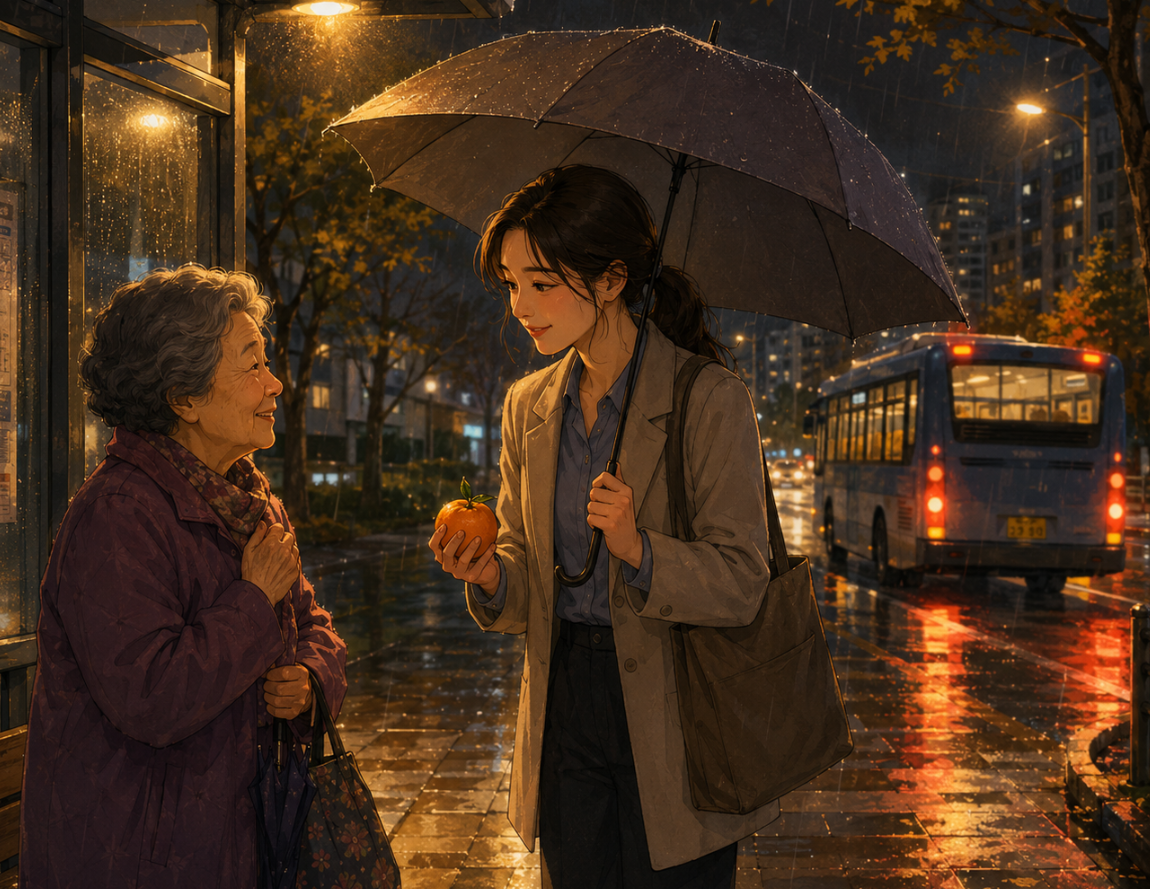
그때 의자에 앉아 있던 한 할머니가 민서를 불렀다.

“저기요, 학생. 혹시 한빛아파트에 가는 버스가 몇 번인지 알아요?”

“잠시만요. 제가 확인해 볼게요.”

Created by AI

민서는 휴대전화로 버스 노선을 검색했다.

“곧 오는 이 버스를 타시면 돼요. 한빛아파트 앞에서 내리시면 돼요.”

“정말 고마워요. 제가 이 동네에 처음 와서 길을 잘 몰라요.”

버스가 도착하자 두 사람은 함께 탔다. 버스 안에는 승객이 거의 없었다.

“한빛아파트에 도착하기 전에 제가 말씀드릴게요.”

“늦은 시간인데 괜히 학생을 귀찮게 하네요.”

“괜찮아요. 저도 같은 방향으로 가요.”

사실 민서가 내려야 할 곳은 한빛아파트보다 한 정거장 전이었다. 하지만 할머니가 다시 길을 잃을까 봐 걱정되어 한빛아파트까지 함께 가기로 했다.

할머니는 가방에서 귤 두 개를 꺼냈다.

“이거 하나 먹어요.”

“아니에요. 괜찮아요.”

“오늘 병원에 다녀오는 길에 샀어요. 하나 받아요.”

민서는 결국 귤 하나를 받았다.

“감사합니다.”

“내가 더 고맙죠.”

잠시 후 버스 안내 방송이 나왔다.

“이번 정류장은 한빛아파트입니다.”

민서는 자리에서 일어났다.

“할머니, 이번에 내리시면 돼요.”

할머니가 먼저 내렸고, 민서도 뒤따라 내리려고 했다.

그때 민서는 할머니가 앉았던 자리에 천 가방이 놓여 있는 것을 발견했다.

“할머니! 가방이요!”

민서는 가방을 들고 급하게 버스에서 내렸다. 문이 닫히고 버스는 출발했다.

할머니는 가방을 보며 깜짝 놀랐다.

“세상에. 가방을 두고 내렸네요.”

“중요한 물건이 들어 있었어요?”

“지갑하고 병원 약이 들어 있어요. 큰일 날 뻔했어요.”

할머니는 가방을 꼭 안았다.

민서는 멀어지는 버스를 바라보았다. 그 버스는 집으로 가는 마지막 버스였다.

“학생도 여기에서 내려요?”

민서는 잠시 망설이다가 대답했다.

“원래는 한 정거장 전에 내려야 했어요.”

“그러면 저 때문에 마지막 버스를 놓친 거예요?”

“괜찮아요. 여기서 걸어갈 수 있어요.”

하지만 민서의 집까지는 걸어서 30분 이상 걸렸다.

할머니는 미안한 표정을 지었다.

“잠깐 기다려요. 우리 아들이 나를 데리러 올 거예요.”

몇 분 뒤 할머니의 아들이 차를 타고 도착했다. 그는 어머니에게 이야기를 듣고 민서에게 고개를 숙였다.

“정말 감사합니다. 비도 많이 오는데 걸어가시면 안 됩니다. 제가 택시를 불러 드릴게요.”

잠시 후 택시가 도착했다.

할머니는 민서의 손을 잡았다.

“오늘 정말 고마웠어요. 조심해서 가요.”

“할머니도 조심히 들어가세요.”

택시 안에서 민서는 할머니에게 받은 귤을 바라보았다.

집에 도착하자 식탁 위에 작은 냄비와 어머니의 메모가 놓여 있었다.

민서야, 늦게까지 수고했어.
배고프면 국 데워 먹어.

민서는 젖은 운동화를 벗고 조용히 웃었다.

마지막 버스는 떠났지만, 그날 밤은 이상하게 따뜻했다.


Natural English Translation

The Last Bus Home

Minseo worked part-time at a small café in Seoul.

There were many customers that day, so she finished later than usual. After wiping the tables and cleaning the floor, she looked at the clock. It was 10:50 p.m.

“Is it already this late?”

Heavy rain was falling outside. The last bus home was scheduled to arrive at 11:05 p.m.

Minseo quickly locked the café and opened her umbrella. By the time she reached the bus stop, her sneakers and the bottom of her pants were wet.

It was 11 p.m.

“What a relief. The bus hasn’t arrived yet.”

The last bus was expected in four minutes.

An elderly woman sitting on the bench called to her.

“Excuse me, young lady. Do you know which bus goes to Hanbit Apartments?”

“One moment. I’ll check for you.”

Minseo searched for the route on her phone.

“You can take the bus that is coming soon. Get off in front of Hanbit Apartments.”

“Thank you. It’s my first time in this neighborhood, so I don’t know the area well.”

When the bus arrived, they boarded together. There were almost no passengers inside.

“I’ll tell you before we reach Hanbit Apartments.”

“I’m sorry to bother you this late.”

“It’s all right. I’m going in the same direction.”

Minseo’s stop was actually one stop before Hanbit Apartments. However, she was worried that the woman might get lost again, so she decided to go with her.

The woman took two tangerines from her bag.

“Have one.”

“No, thank you. I’m all right.”

“I bought them on my way home from the hospital. Please take one.”

Minseo eventually accepted a tangerine.

“Thank you.”

“I’m the one who should be thankful.”

A short time later, the bus announcement played.

“This stop is Hanbit Apartments.”

Minseo stood up.

“Ma’am, you should get off here.”

The woman got off first. As Minseo was about to follow her, she noticed the woman’s cloth bag still lying on the seat.

“Ma’am! Your bag!”

Minseo grabbed it and hurried off the bus. The doors closed, and the bus left.

The woman was shocked.

“Oh my goodness. I left my bag on the bus.”

“Were there important things inside?”

“My wallet and hospital medicine are in it. I almost had a serious problem.”

She held the bag tightly.

Minseo watched the bus disappearing. It was the last bus going toward her home.

“Do you also get off here?”

Minseo hesitated before answering.

“I was supposed to get off one stop earlier.”

“Did you miss the last bus because of me?”

“It’s all right. I can walk from here.”

However, it would take more than 30 minutes to walk home.

The woman looked sorry.

“Please wait. My son is coming to pick me up.”

A few minutes later, her son arrived by car. After hearing what had happened, he bowed to Minseo.

“Thank you so much. It’s raining too heavily for you to walk. I’ll call a taxi.”

A taxi arrived soon afterward.

The elderly woman held Minseo’s hand.

“Thank you for today. Please get home safely.”

“You too. Have a safe night.”

Inside the taxi, Minseo looked at the tangerine the woman had given her.

When she arrived home, she found a small pot and a note from her mother on the table.

Minseo, you worked hard until late.
Heat the soup if you are hungry.

Minseo took off her wet sneakers and smiled quietly.

The last bus had left, but that night felt strangely warm.


Essential Vocabulary

KoreanRomanizationMeaning

아르바이트 areubaiteu part-time job
마지막 버스 majimak beoseu last bus
정류장 jeongnyujang bus stop
노선 noseon bus route
승객 seunggaek passenger
정거장 jeonggeojang bus stop
길을 잃다 gireul ilta to get lost
걱정되다 geokjeongdoeda to be worried
권하다 gwonhada to offer
놓치다 nochida to miss
망설이다 mangseorida to hesitate
yak medicine
큰일 나다 keunil nada to have a serious problem
택시를 부르다 taeksireul bureuda to call a taxi
수고하다 sugohada to work hard

Key Grammar

1. -(으)ㄹ까 봐

This expression means “because someone is worried that something may happen.”

Story Example

할머니가 다시 길을 잃을까 봐 걱정됐다.

Minseo was worried that the elderly woman might get lost again.

More Examples

비가 올까 봐 우산을 가져왔어요.
I brought an umbrella because I was worried it might rain.

버스를 놓칠까 봐 일찍 출발했어요.
I left early because I was worried I might miss the bus.


2. -(으)ㄹ 뻔하다

This grammar means “something almost happened, but did not.”

Story Example

큰일 날 뻔했어요.

I almost had a serious problem.

More Examples

넘어질 뻔했어요.
I almost fell.

지갑을 잃어버릴 뻔했어요.
I almost lost my wallet.


3. -지만

-지만 connects two contrasting ideas and means “but” or “although.”

Story Example

마지막 버스는 떠났지만, 그날 밤은 따뜻했다.

The last bus had left, but that night felt warm.

More Examples

비가 오지만 산책하고 싶어요.
It is raining, but I want to take a walk.

피곤하지만 공부해야 해요.
I am tired, but I have to study.


Useful Korean Expressions

KoreanNatural English Meaning

혹시 아세요? Do you happen to know?
제가 확인해 볼게요. I’ll check for you.
이 버스를 타시면 돼요. You can take this bus.
내가 더 고맙죠. I’m the one who should be thankful.
큰일 날 뻔했어요. I almost had a serious problem.
조심히 들어가세요. Get home safely.
늦게까지 수고했어. You worked hard until late.

Korean Culture Notes

Why Did the Woman Call Minseo “학생”?

학생 literally means “student.” In Korea, an older person may sometimes use it to address a young stranger, even without knowing whether the person is actually a student.

It is a friendly form of address in informal daily situations.

Offering Food to Show Gratitude

The elderly woman gives Minseo a tangerine to express her gratitude.

In Korea, offering fruit, snacks, or drinks is a common way to thank someone. The receiver may politely refuse once before accepting.

아니에요. 괜찮아요.
No, thank you. I’m all right.

This first refusal may express politeness rather than a definite rejection.


Reading Comprehension Quiz

1. Where did Minseo work?

A. At a hospital
B. At a café
C. At a school
D. At a library

2. Why did the elderly woman ask for help?

A. She had lost her wallet.
B. She did not know which bus to take.
C. She needed to call a hospital.
D. She had missed her bus.

3. Why did Minseo pass her own stop?

A. She fell asleep.
B. She wanted to meet a friend.
C. She wanted to help the elderly woman.
D. The bus driver made a mistake.

4. What was inside the woman’s bag?

A. A wallet and medicine
B. Fruit and clothes
C. A phone and books
D. An umbrella and food

5. Why did the night feel warm to Minseo?

Write your answer in one or two sentences.


Quiz Answers

  1. B — At a café
  2. B — She did not know which bus to take.
  3. C — She wanted to help the elderly woman.
  4. A — A wallet and medicine
  5. Minseo felt warm because she helped someone, received kindness in return, and found a caring note from her mother at home.

Final Review

After studying this story, you should be able to:

  • Ask politely which bus to take.
  • Understand common transportation vocabulary.
  • Describe something that almost happened.
  • Express worry with -(으)ㄹ까 봐.
  • Connect contrasting ideas with -지만.
  • Understand small acts of kindness in Korean daily life.

Read the Korean story one more time without looking at the English translation. Try to find the expressions that you could use in a real conversation.

작은 친절은 때때로 마지막 버스보다 더 멀리 우리를 데려다준다.

A small act of kindness sometimes takes us farther than the last bus.


This is an original educational short story created for K-Fiction.com. All characters and events are fictional.

'k-story-lessons > A2' 카테고리의 다른 글

The Photograph Between the Pages  (1) 2026.07.28
The Recipe in the Paper Bag  (0) 2026.07.28
The Package at the Wrong Door  (0) 2026.07.28
The Seat by the Window  (1) 2026.07.28
The Lunchbox with No Name  (0) 2026.07.28